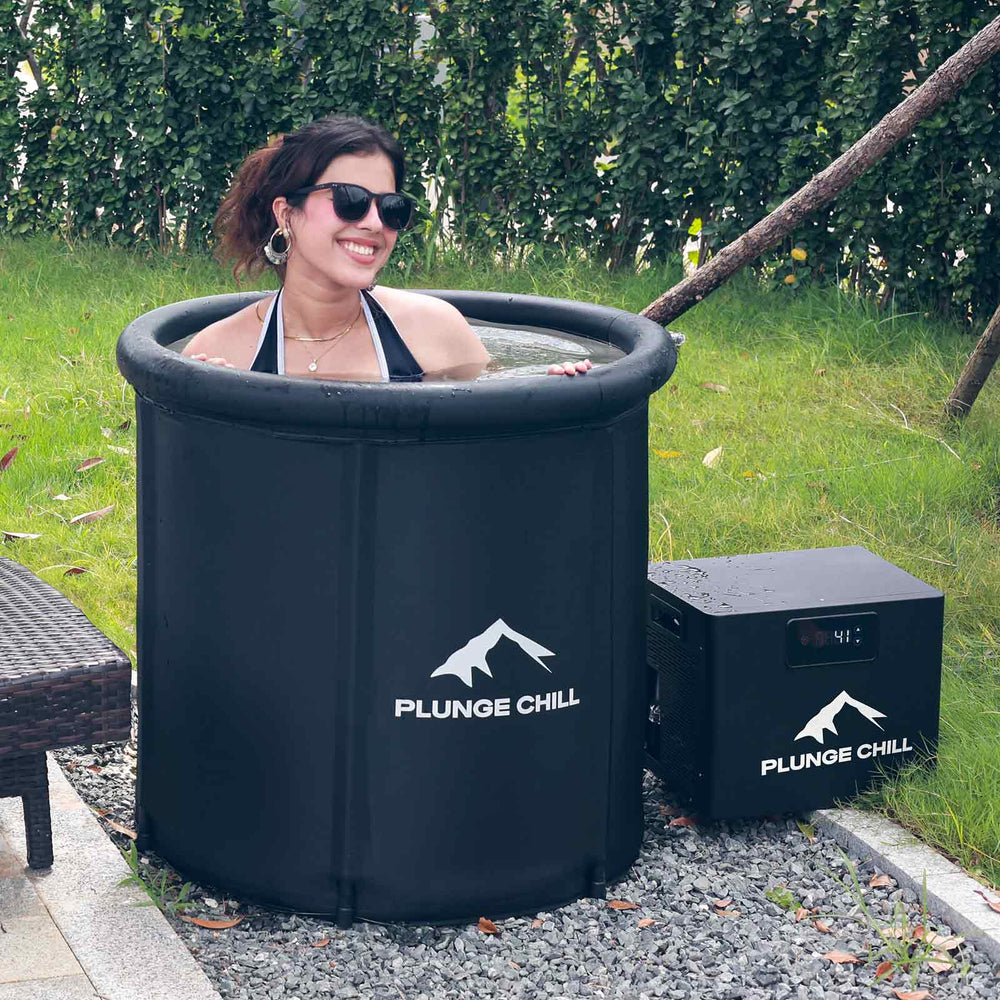
There are usually two ways people set up an ice plunge. The first is the old-school method—fill a tub with water, dump in a lot of ice, and wait. It gets the job done, but it’s not exactly convenient.
The second option is a cold plunge chiller. With a chiller, the water stays cold automatically and you don’t have to keep buying ice.
That’s why chillers have become so popular. The interesting part is how they actually keep the water cold.

How a Cold Plunge Chiller Works
Before we get to the complex mechanism, please first think about the refrigerator in your kitchen, or the air conditioner in your room—both of them don't actually "make" cold, but they remove heat—and the cold plunge chiller is the same. At its core, it is a heat extraction system for your tub.
And for the whole heat-removing process, there is a special liquid called refrigerant, which will continuously cycle through the system. This refrigerant has a special ability: it absorbs heat from one place (your bath water) and releases it somewhere else (the air around the unit).
As the refrigerant moves through different components—getting compressed, expanding, changing from liquid to gas and back again—it pulls warmth out of your water and expels it from the chiller.
And as a result, your plunge tub steadily drops from the room temperature down to that bracing 39-50°F range that delivers all those recovery benefits.
Unlike passive cooling like adding ice, an ice bath chiller actively and continuously keeps your target temperature in the tub, even when your body temperature is rising in the session or the sunlight is scorchingly hot.

COLD PLUNGE CHILLER
Main Parts of a Cold Plunge Chiller System
To make the best ice bath experiences, there are four necessary parts inside every chiller for cold plunging.
The Compressor
Think of the compressor as the engine of your cold plunge chiller. Its one and only job is to pump a special cooling liquid (refrigerant) around in a loop.
Here’s how it works in the cooling process:
- It Squeezes: The compressor takes in the refrigerant (as a gas) and squeezes it really hard. Just like a bicycle pump gets hot when you use it, squeezing this gas makes it super hot and puts it under high pressure.
- It Pushes Heat Out: This hot, high-pressure gas is then pushed to a different part of the chiller (the condenser) where it releases all that heat into the outside air. You might feel warm air blowing from the chiller's vent—that's the heat that used to be in your water!
- It Enables the Chill: After dumping its heat, the refrigerant turns into a very cold liquid. This icy-cold liquid then flows through pipes that are in contact with your plunge's water, sucking the heat out of the water and making it cold.
- It Repeats: The refrigerant, now warmed up from absorbing your water's heat, flows back to the compressor to get squeezed again, and the whole cycle repeats.
So, the compressor doesn't directly make the water cold. Instead, it powers the whole process that moves heat from inside your water to the air outside.
When you see a rating like 1 HP (horsepower), that's just a measure of the compressor's strength. A stronger compressor (higher HP) is like a bigger, more powerful engine. It can move more heat, more quickly, which means it can:
- Cool your water down faster.
- Keep the water icy cold even on a hot day.
- Handle larger amounts of water more easily.

The Heat Exchangers
Your chiller has two "heat traders" that work as a team. One's job is to dump heat outside, and the other's job is to pull heat from your water.
The Condenser (The Heat Dumper)
Think of this as the chiller's radiator.
After the compressor squeezes the refrigerant and makes it super hot, this hot gas flows into the condenser. The condenser is a set of coils with a fan blowing on them.
- Its Job: To get rid of all that heat and dump it into the air.
- How: The fan blows air across the coils, and the heat escapes from the hot refrigerant into the air.
- What you see: This is why you feel hot air blowing out of your chiller. That's all the heat that used to be in your water! As the refrigerant loses its heat, it cools down and turns back into a liquid.
The Evaporator (The Water Chiller)
This is the part that actually makes your water cold.
The cold liquid refrigerant (which just cooled down in the condenser) flows into this second set of coils, called the evaporator. These coils are what your plunge water flows over or through.
- Its Job: To suck the heat out of your water.
- How: As the refrigerant flows through these coils, it "boils" and turns from a cold liquid back into a gas. To do this, it needs energy, so it absorbs heat from its surroundings—which is your water!
- What you see: Your water circulates past these icy-cold tubes (often made of titanium so they don't rust) and its heat gets pulled right out, making the water cold.
So, in short:
- The Evaporator pulls heat out of your water.
- The Compressor squeezes that heat into a small space.
The Refrigerant
As we've mentioned in the previous paragraphs, refrigerant is the "special liquid" that cycles through the system, absorbing and releasing heat. And do you know how can this special chemical achieve all that?
It's all because it can easily change from a liquid to a gas (and back again) at very low temperatures. And this continuous transformation allows it to transport heat:
- It absorbs heat when it evaporates (turns from a liquid to a gas) in the Evaporator, which is what pulls the warmth out of your water.
- It releases heat when it condenses (turns from a gas back to a liquid) in the Condenser, which is what dumps that warmth into the outside air.
This endless cycle is the engine of the whole system, constantly pulling heat from your tub and moving it away.
Even Better, modern chillers use environmentally friendly types like R410A, which don't harm the ozone layer, protecting environment and helping with your health, at the same time.
The Water Pump and Filtration System
For a chiller to cool your water effectively, the water needs to keep moving through the system. A built-in pump pulls water from the tub through an intake hose, sends it through the cooling unit, and then returns it back into the tub at a lower temperature.
Many modern systems are designed as a cold plunge chiller with filter, meaning the unit not only cools the water but also filters it at the same time. The filter captures hair, debris, body oils, and other small particles before the water reaches the internal cooling components.
This setup helps keep the water cleaner for longer while also protecting the chiller from buildup that could affect performance over time.

1HP COLD PLUNGE CHILLER
Cold Plunge Cooling Process Step by Step
Now that you know the key players, let's follow your water through a complete cooling cycle to see how everything works together.

Step 1: Water Intake — The pump activates and draws relatively warm water from your plunge tub through the intake hose. The flow rate typically ranges from 40-60 gallons per minute, depending on the chiller's size and power.
Step 2: Filtration — Before reaching the cooling components, the water passes through the filter basket or cartridge. This removes physical contaminants that could clog the narrow passages in the evaporator or reduce heat transfer efficiency.
Step 3: Heat Exchange — The clean water enters the evaporator and flows around or through the titanium coils. Inside these coils, the cold refrigerant is rapidly expanding from liquid to gas. As it does so, it's desperately pulling heat energy from its surroundings—your water. The water temperature can drop several degrees during this single pass through the evaporator.
Step 4: Water Return — The newly chilled water exits the chiller through the output hose and flows back into your tub. Because the cooler water is denser, it naturally sinks and displaces the warmer water at the bottom, which then gets circulated back into the chiller. This creates a continuous circulation pattern that gradually brings the entire volume down to your target temperature.
Step 5: The Refrigerant's Continuous Loop — Meanwhile, the refrigerant that absorbed your water's heat has traveled to the compressor, where it's pressurized into a hot gas. This hot gas flows into the condenser, where it releases that captured heat to the outside air and converts back to a cool liquid. The liquid refrigerant then moves through an expansion valve, which reduces its pressure right before it enters the evaporator again. This pressure drop causes the refrigerant to cool even further, preparing it to absorb more heat from your water. The cycle repeats continuously, pulling more and more warmth out of your tub until it reaches your set temperature.

Not All Chillers Are Created Equal: What Really Matters?
When you look for a cold plunge chiller, you'll see a big difference in price and power. These aren't just marketing—they change how well your chiller works. Here’s a simple breakdown of the features that matter.
1. Horsepower (HP): The "Engine" of Your Chiller
Think of horsepower (HP) as the strength of the chiller's engine. A bigger engine (like Plunge Chill 1 HP chiller's) is much more powerful than a smaller one (like Plunge Chill 1/3 HP chiller's). This "engine size" directly affects your experience in four key ways:

Cold Plunge Tub with Chiller
Raw Cooling Speed: A 1 HP chiller is like a sports car—it's powerful. It pulls heat out of your water three to four times faster than a 1/3 HP unit. This is the difference between your water getting cold in under an hour versus taking several hours.
How Cold It Can Get: A small 1/3 HP "engine" will struggle to push the temperature below 45°F (some better models like Plunge Chill's 1/3 HP chiller can make it down to 39°F). A strong 1 HP engine has the extra power to get your water all the way down to an icy 37°F-39°F.
Fighting Hot Weather: Your chiller works by "dumping" the heat from your water into the air. On a hot 90°F day, this is much harder to do. A small 1/3 HP unit will struggle and might only cool your water to 55°F. A 1 HP unit has the muscle to power through the hot weather and still hit 39°F without a problem.
Recovery Time (This is a big one!): When you get in, your body heat warms up the water. After you get out, a 1/3 HP chiller might take 45 minutes to get the water cold again. A 1 HP unit can do it in just 10-15 minutes. If two people want to plunge, or you do multiple sessions, a 1 HP unit means you're always ready to go.

2. All-in-One vs. Separate Parts
This is about the chiller's basic design and how easy it is to set up.
Old-School (Separate Parts): In the past, you had to buy a chiller unit, a separate pump, and a separate filter. You then had to connect them all with pipes. This was complicated, messy, and could easily leak.
Modern (All-in-One): Nearly all good, modern chillers are "all-in-one." This means the chiller, pump, and filter are all built into one smart box. It's like buying a new laptop instead of building a computer from parts. Everything is designed to work together perfectly, it's more reliable, and there are no messy external pipes to worry about.
3. Smart Controls vs. Basic Thermostats
This feature controls how your chiller keeps the water cold.
Basic Chillers (On/Off): These use a simple thermostat, like an old heater. When the water gets too warm, the chiller turns ON at 100% power. When it's cold enough, it turns completely OFF. This makes the temperature bounce around, swinging 2-5 degrees above and below your target.
Smart Chillers (Cruise Control): Advanced chillers use digital controls, which work like cruise control in your car. Instead of slamming on and off, they make tiny, constant adjustments, speeding up or slowing down the compressor as needed. This gives you three huge benefits:
- Stable Temperature: The water stays locked at your exact target (e.g., 39°F) instead of swinging from 38°F to 43°F.
- Energy Savings: This "cruise control" method is much more energy-efficient and saves you money on your electric bill.
- Longer Life: It's much gentler on the machine's parts, helping the chiller last for many more years.
The Top Benefits of Upgrading to a Chiller
Moving from ice-filled tubs to a dedicated chiller transforms your cold plunge practice in several meaningful ways.
You Get Perfect Temperature, Every Single Time
You can enjoy consistent cold plunge therapy at your exact target temperature—whether that's 45°F, 50°F, or whatever works for your body. No more walking out to find lukewarm water because the ice melted overnight. No more guessing if it's cold enough to be effective. You'll actually stick to your routine because your plunge is always ready when you are.

You Stop Wasting Time on Ice Runs
You eliminate the exhausting cycle of buying, hauling, and dumping ice bags every single day. No more last-minute store runs. No more ice-burned fingers. No more heavy lifting. You simply walk outside and plunge. You're investing your energy in recovery, not in logistics.
You Save Money Over Time
You stop the ongoing expense of buying ice bags multiple times per week. While a chiller has an upfront cost, you eliminate the recurring ice purchases that add up month after month. The electricity to run a chiller costs far less than constantly buying ice, and you get better, more reliable performance.
You Enjoy Cleaner Water with Less Work
You can go much longer between water changes compared to ice-based systems. The built-in filtration continuously removes contaminants, so your water stays fresh and inviting. Less time with the hose, less hassle, less waste.
You Reduce Your Environmental Footprint
You stop generating plastic bag waste from ice, eliminate emissions from ice production and delivery, and drastically cut water waste from constant refills. You get superior recovery while treading lighter on the planet.
Maintenance of Your Chiller
Your cold plunge chiller needs very little maintenance—just a few simple tasks to keep it running well for years.
What to Do and When
| How Often | What to Do | Why It Matters |
|---|---|---|
| Every Week |
• Clean the filter (rinse out hair and debris) • Test water (check pH is 7.2-7.8) |
Keeps water flowing properly |
| Every Month |
• Check for leaks • Make sure air can flow around the unit • Wipe off dust |
Prevents problems early |
| Every 2-3 Months | • Clean the coils with a soft brush | Saves energy, cools better |
|
Before Winter (freezing areas only) |
• Drain all water out | Prevents freeze damage |
Simple Care Tips
The filter pulls out easily—just rinse it under a hose once a week. Takes less than 2 minutes.
Water chemistry should stay balanced. Keep pH between 7.2-7.8 and add chlorine or bromine as needed. Don't use too much or it can damage parts.
Keep space around the unit clear so air can flow. Blocked air = poor cooling.
In winter, if it gets below freezing and you're not using the chiller, drain the water out completely. Check your manual for how to do this.
Conclusion
Knowing how your cold plunge chiller works, from the science of the compressor to the cycles of the refrigerant, helps you make better choices about horsepower, placement, and maintenance. Not only do these machines cool water, but they also make cold therapy easier by automating the process of using ice. If you have the right chiller for your needs, consistent ice-cold recovery is always here ready for you.
For high-quality and yet affordable cold plunge chillers, please visit Plunge Chill.