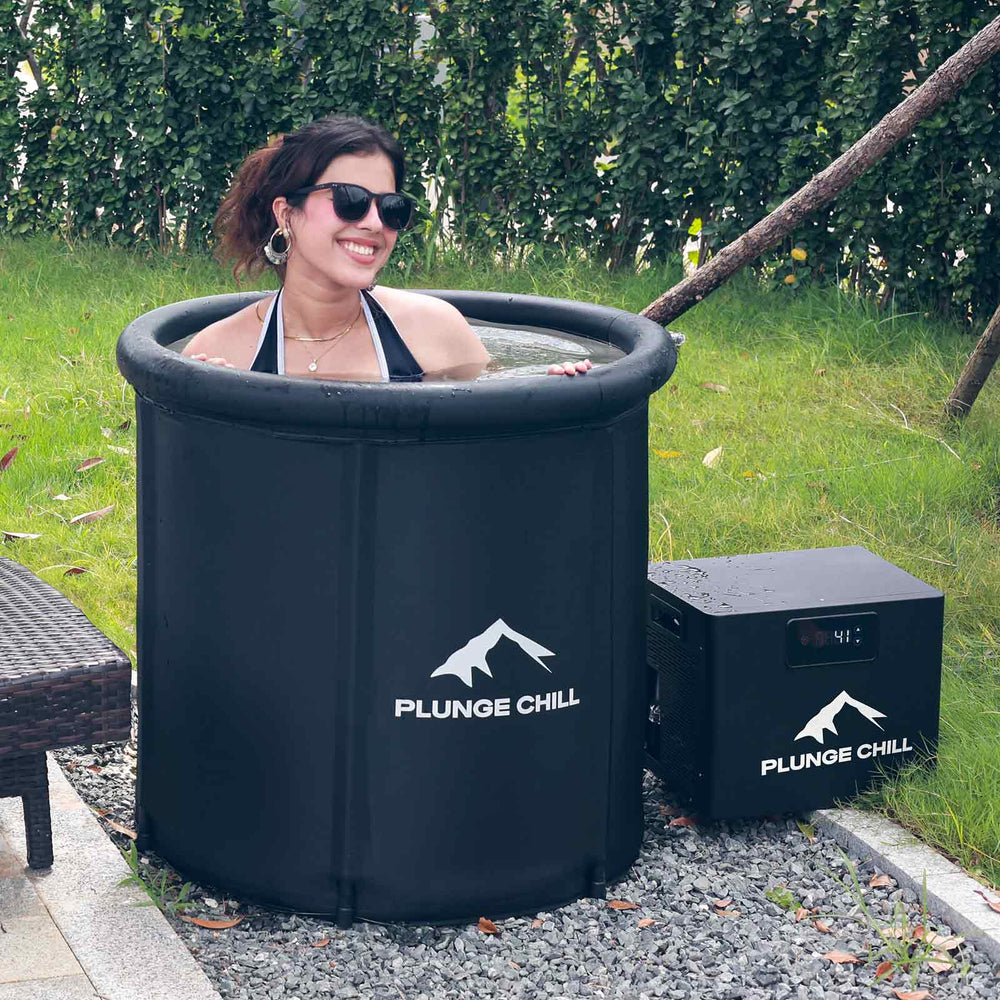
A saltwater cold plunge tub uses dissolved salt and a salt-chlorine generator to help sanitize the water during cold immersion therapy. While saltwater systems are common in pools and hot tubs, their use in cold plunge setups raises important questions about sanitation, equipment compatibility, and performance at low temperatures. This guide distills what actually matters: the physiology behind benefits, how salt systems behave in cold water, how to keep the water safe and clear, what to buy, and how to use your tub without compromising long‑term training adaptations.
What Is a Saltwater Cold Plunge Tub?
A saltwater tub is not simply “water with salt.” In hot tubs, a salt‑chlorine generator splits dissolved salt to produce a steady trickle of chlorine that keeps water sanitized. Build a DIY Hot Tub explains that you add roughly two pounds of salt per 100 gallons and the cell maintains a low-level chlorine residual with less noticeable odor and fewer additives than manual dosing. That model drives most saltwater marketing.
Cold plunges are different because operating temperatures sit around 39–59°F. Many salt‑chlorine cells shut down below about 60°F to protect the cell and because conversion efficiency drops in cold water. That means a plunge kept at 39–55°F will not generate fresh sanitizer if you rely on a conventional salt cell alone. If you add salt without a functioning generator, the salt itself does not sanitize the water.
There are workable strategies. Some owners schedule brief “warm sanitation cycles” above 60°F to let the cell run, then return to cold. Others choose sanitizers that do work at cold temperatures and keep salt out entirely, or they run hybrid setups that combine low‑salt for feel with a non‑chlorine sanitizer plus ozone or UV to control microbes. Icebound Essentials, a water‑care reference used by cold‑plunge manufacturers, emphasizes that cold slows bacterial growth and chemical reactions at the same time; you may need fewer chemicals in cold water, but they act more slowly, so residual testing still matters.

Why Cold Plunge Works for Recovery — and When It Doesn’t
Cold exposure triggers rapid vasoconstriction, reduces tissue temperature and metabolism, and blunts acute swelling and proteolysis, which can reduce soreness and restore next‑day performance. Mayo Clinic Health System and Ohio State Health both describe these mechanisms and note that rewarming subsequently increases blood flow and helps move metabolites. University of Utah Health summarizes emerging evidence on brown adipose tissue activation and thermogenesis, citing cohorts of winter swimmers and protocols that average about eleven minutes per week across a few sessions. Harvard Health reviewed pooled studies and reported reduced stress and improved sleep in men, with heterogeneous protocols that limit firm dose–response conclusions.
The same pathways that dampen inflammation can interfere with the molecular signals you rely on to build strength and muscle. Post‑exercise cold exposure can blunt hypertrophy adaptations, as both Mayo Clinic Health System and sports science papers referenced by Ohio State Health and PubMed Central reviews note. If your primary goal is muscle growth or maximal strength, separate cold exposure from lifting by at least a day, or plunge before, not after, resistance sessions. If you prioritize rapid turnaround, tournament recovery, or endurance performance, post‑session plunges remain reasonable.

Key Considerations for Saltwater Systems in Cold Plunge Tubs
One critical detail gets glossed over in sales materials. Salt‑chlorine generators commonly inhibit or shut down their cells at or below about 60°F. That threshold is unremarkable in hot tubs but is routine in cold plunges. When the water is cold, the cell likely is not making chlorine. This is not a minor nuance; it defines whether a salt system can sanitize your plunge at all. Source: Build a DIY Hot Tub; conclusion corroborated by manufacturer guidance across salt cell lines.
A second nuance is that bromine tends to perform more consistently than chlorine in cold water, which is why Icebound Essentials lists bromine at 3–5 ppm as a preferred cold‑plunge residual, with chlorine at 1–3 ppm and hydrogen peroxide at 30–50 ppm when paired with ozone. Many saltwater marketing pages skip this because bromine and peroxide do not come from a salt cell, but both can be more reliable at 39–50°F.
A third point is buoyancy. You may hear claims that saltwater buoyancy reduces joint loading enough to meaningfully enhance comfort. Typical salt‑cell salinity is around 2,000–3,500 ppm, far below ocean water. The resulting change in buoyancy is modest and may not be clinically meaningful for most users. A simple verification step is to compare perceived joint unloading and heart rate in fresh water versus a low‑salinity tub at the same temperature in the same session.
Cold Plunge Timing: Before or After a Workout?
The way you schedule cold exposure matters more than most people think. For hypertrophy blocks, wait twenty‑four to forty‑eight hours after lifting before immersing to avoid dampening the inflammatory signaling that drives satellite cell activity and protein synthesis. For endurance or mixed‑sport recovery, plunging within about an hour after training can reduce soreness and restore performance sooner, as summarized by Mayo Clinic Health System and the PubMed Central review. For metabolic or mood effects, short exposures distributed across the week, totaling roughly eleven minutes, align with University of Utah Health’s synthesis of winter‑swimming cohorts. Ohio State Health cautions that the evidence is mixed overall and quality varies, which is why anchoring to your training goal is more practical than chasing a universal protocol.

How to Maintain Clean Water in a Cold Plunge Tub
Cold water changes the pace of all reactions. Icebound Essentials outlines practical targets that translate well to cold plunges: keep pH between 7.2 and 7.8, total alkalinity between 80 and 120 ppm, and calcium hardness around 100 to 250 ppm in acrylic tubs. Those targets stabilize pH and reduce corrosion or scale. For residual sanitizer in cold, bromine at 3–5 ppm is forgiving and effective. If you want a chlorine residual, aim for 1–3 ppm and be patient with dosing because reaction rates are slower. Hydrogen peroxide at 30–50 ppm works synergistically when you also run a good ozone system. Icebound Essentials even provides practical peroxide dosing examples for 100–150 gallons, noting that about one‑half cup of 30% peroxide in 100 gallons is a common start point, with circulation for fifteen to twenty minutes and measured verification before adjusting. Keep in mind that peroxide alone is not a residual sanitizer in the same way chlorine or bromine is, which is why ozone or UV are layered in to reduce overall demand.
Chill Tubs’ consumer guidance aligns with clinical practice: shower before entry to limit skin oils and hair, wipe the waterline, keep a cover on between sessions, and position the tub in a clean, ventilated area. For basic inflatable pods without active filtration, change water every three to four days. For advanced chilled systems with filtration and ozone, a cadence closer to every two weeks is common. Those intervals shorten with heavy traffic and lengthen when residuals, filtration, and users’ hygiene are consistently good.
Safety First: Cold Shock, Medical Screening, and Practical Precautions
The American Heart Association has repeatedly warned that sudden immersion in water under 60°F can provoke a cold shock response—gasping, hyperventilation, spikes in heart rate and blood pressure—that increases drowning and cardiac risk in open water. In a home plunge, you control depth, time, and exit, but the physiology is the same. University of Utah Health notes that blood pressure commonly rises and heart rate can drop during immersion; that combination is tolerable for healthy people but can be hazardous if you have cardiovascular disease, diabetes with neuropathy, or autonomic dysfunction. Mayo Clinic Health System and Ohio State Health both recommend medical clearance when you have cardiovascular risk factors, and I do the same in clinic.
Build tolerance gradually. Start with brief cold showers if you are new, then move to short immersions in a controlled setting with a partner present. Keep warm layers, dry towels, and a warm beverage within arm’s reach. Avoid rivers, currents, or unsupervised natural settings. If you shiver uncontrollably, feel dizzy, or lose dexterity, exit and rewarm. If you use contrast with a sauna, be mindful that the jump from hot to very cold increases hemodynamic load; proceed conservatively, especially if you have hypertension or arrhythmia risk.

Can a Salt‑Chlorine Generator Work Below 60°F?
This is the central engineering constraint for saltwater cold plunges. At common plunge temperatures, most residential salt cells throttle or stop. If you want the “salt feel” and chlorine made from salt without handling tabs or liquid, you need to either schedule periodic warm sanitation cycles, add an inline heater bypass loop for brief warm‑ups, or choose a generator designed for lower‑temperature operation and verify its performance curve. Otherwise, treat the tub as a low‑salinity bath for comfort and run bromine, low‑dose chlorine, or peroxide plus ozone for sanitation. Build a DIY Hot Tub details how salt systems reduce perceived chemical load in hot tubs, but the same hardware becomes unreliable in cold water. This is why many athletic training rooms specify bromine systems for dedicated cold plunges and reserve salt‑chlorine for hot hydrotherapy units.

Materials, Metals, and Salt: What to Buy and Why
Salt increases corrosion risk for metals and fittings. Low temperatures slow some corrosion mechanisms but do not eliminate chloride stress cracking in susceptible alloys. If you truly plan to keep salt in the water, prioritize a titanium heat exchanger, 316 or 316L stainless in wetted parts, and plastics or composites designed for low‑salinity service. Verify the maximum allowed salinity for your chiller, pump, and ozone unit; many chillers cap salt at specific parts per million, beyond which warranties lapse.
Here is a quick compatibility snapshot to guide purchases.
|
Component |
Preferred material |
Salt tolerance notes |
What to verify |
|
Heat exchanger/coil |
Titanium |
Best‑in‑class chloride resistance |
Max salinity rating and warranty language |
|
Pump wetted parts |
316/316L stainless or polymer |
Avoid 304 stainless in saline |
Seal materials and impeller composition |
|
Fasteners/fittings |
316 stainless |
Prevent galvanic pairs with aluminum |
Galvanic isolation and bonding |
|
Tub shell/plumbing |
Acrylic/PVC/CPVC |
Chemically compatible with low salinity |
Pressure and temperature rating at 39–59°F |
|
Lighting/heaters |
Salt‑rated housings |
Cable glands and gaskets resist chloride |
IP rating and salt spray certifications |
Sanitizer Options That Work at 39–59°F
If your goal is reliable sanitation at plunge temperatures, the table below summarizes real‑world options and trade‑offs.
|
Approach |
Works at 39–59°F |
Typical target |
Strengths |
Limitations |
Best fits |
|
Salt‑chlorine generator |
Not reliably; many cells shut down below 60°F |
1–3 ppm free chlorine |
Low handling when warm |
Needs warm cycles; cell wear; corrosion risk |
Hybrid systems with scheduled warm‑ups |
|
Bromine (tabs/liquid) |
Yes |
3–5 ppm total bromine |
Stable and effective in cold water |
Tablets need feeder; odor for some users |
Dedicated cold plunges needing steady residual |
|
Chlorine (liquid) |
Yes |
1–3 ppm free chlorine |
Widely available, predictable |
Slower reaction in cold; pH drift |
Small tubs with diligent testing |
|
Yes |
30–50 ppm peroxide |
Oxidizes organics; fewer halogen byproducts |
Peroxide not a halogen residual; needs ozone |
Sensitive‑skin users; tubs with good ozone |
|
|
UV + halogen residual |
Yes |
Residual per halogen chosen |
UV inactivates microbes passing the chamber |
No residual by itself |
High‑flow filtered systems |
Icebound Essentials provides the target bands above and practical dosing guidance for peroxide with circulation time before re‑testing. For small volumes, a drain‑and‑refill strategy every few weeks can be part of an overall plan, but even small tubs benefit from simple filtration and a consistent sanitizer residual.
Session Protocols by Goal
The best protocol depends on what you want from the plunge and what you are willing to give up.
|
Goal |
Water temperature |
Session length |
Timing vs training |
Notes |
|
Soreness reduction and next‑day readiness |
50–59°F |
10–20 minutes |
Within about one hour post‑endurance or mixed sessions |
Reported benefits for performance restoration; evidence mixed but favorable for endurance recovery per Ohio State Health and Mayo Clinic Health System |
|
Strength/hypertrophy preservation |
50–59°F or colder for brief exposures |
Short sets totaling 5–11 minutes across week |
Avoid 24–48 hours after lifting |
Post‑lift immersion can blunt growth signals; separate days or plunge before lifting |
|
Metabolic/thermogenesis |
50–57°F |
Short repeated bouts |
Any day; weekly total about eleven minutes |
University of Utah Health cites cohorts at about eleven minutes per week linked to brown fat activation |
|
Mood and alertness |
50–59°F |
One to five minutes |
Morning or mid‑day |
Mayo Clinic Health System and Harvard Health summarize mood and stress improvements with heterogeneous dosing |

Care and Maintenance You Can Sustain
In clinics and team rooms, the tubs that stay crystal clear follow the same simple pattern. Keep users disciplined: quick soap shower before entry, no lotions, and clean suits help reduce organics and foam. Test water every one to two weeks for pH, alkalinity, and sanitizer, and after any unusual demand such as a large group session. Target pH between 7.2 and 7.8 and total alkalinity between 80 and 120 ppm to stabilize pH. Run filtration at least a few hours daily; clean the filter every two to three weeks, and replace only when damaged or performance drops.
If you use peroxide plus ozone, add peroxide slowly with pumps running, circulate for fifteen to twenty minutes, then re‑test before redosing. For bromine or chlorine residuals, adjust alkalinity first, then pH, then calcium if needed, and finally the sanitizer—this order reduces chasing your tail on pH swings. Keep the cover on between sessions to limit debris and evaporation, and wipe the waterline weekly to prevent scum buildup. Plan for periodic water changes based on traffic. Basic pods without filtration often need water replaced within a few days; advanced chilled systems with filtration, ozone or UV, and a halogen residual commonly stretch to one to two weeks between changes, as Chill Tubs advises.
Buying Guide: What Matters in a Saltwater‑Ready Cold Plunge
If you want the skin feel of salt and the low‑odor experience people associate with salt systems, purchase with the cold constraint in mind. Choose a chiller with a titanium heat exchanger and confirm a maximum salinity rating in writing. Ask about the sanitizer strategy at 39–59°F, not just at hot‑tub temperatures. If the seller pushes a salt cell without addressing operation below 60°F, expect to add a bromine feeder, liquid chlorine dosing, or an ozone‑peroxide plan.
Filter quality matters more than most realize; look for filters that capture down to about five to twenty microns and are easy to hose off. Verify that plumbing uses PVC or CPVC with cold‑temperature pressure ratings. Evaluate ergonomics: safe step‑in height, handholds, a reliable lid, and a drain that clears the last inch of water all make weekly care easier. Finally, consider the noise profile and heat exhaust of the chiller if the tub sits in an apartment or small training room; good units provide decibel ratings and exhaust direction.
As a product reviewer, I prioritize three questions during demos. First, what keeps the water safe at 39–55°F on a normal week when athletes are using it daily. Second, which wetted components are titanium or 316L stainless, and what salinity is the warranty rated for. Third, how quickly can the unit be serviced with off‑the‑shelf filters and seals. It is better to buy a frank, well‑supported fresh‑water system with excellent filtration and an ozone‑bromine plan than a salt‑cell package that stops working the moment you make the water cold.
Reconciling Conflicting Evidence
Not all references agree, and the disagreements make sense once you examine who was studied, where, and why. University of Utah Health points out that many cold exposure studies enroll young, healthy winter swimmers; the effects seen in that population do not automatically carry over to older adults or people with cardiometabolic disease. Harvard Health’s synthesis notes protocol heterogeneity that blunts strong dose–response claims, while Ohio State Health and Mayo Clinic Health System caution that post‑workout immersion can hinder strength and muscle growth over time. Differences likely stem from definitions and endpoints. Winter swimmers who self‑select into open‑water exposure are not the same as lifters in a hypertrophy block, and the outcome of interest—mood, soreness, brown fat activation, next‑day power—changes the recommended timing and dose. In practical terms, this is why I anchor protocols to your training goal rather than trying to copy a single universal routine.
A Note on Saltwater Comfort Claims
Some hot tub resources highlight the feel of saltwater as gentler on skin and eyes, and in warm water that matches users’ experience. In cold plunges I see the comfort difference less tied to salt and more tied to sanitation strategy and water balance. Fewer additives, correctly balanced pH and alkalinity, and a clean filter do more for skin feel than low‑level salinity alone at 39–55°F.
Takeaway
Cold plunges can meaningfully reduce soreness, sharpen alertness, and support tight turnaround between sessions, but they can also blunt strength and hypertrophy if you plunge immediately after lifting. Salt systems provide a pleasant water feel in hot tubs, yet in cold water many salt‑chlorine cells stop generating sanitizer. If you truly want salt in a plunge, plan for warm sanitation cycles or choose a cold‑tolerant sanitizer such as bromine, or pair hydrogen peroxide with ozone while keeping salt concentrations low and materials compatible. Regardless of chemistry, the tubs that perform best are the ones with disciplined user hygiene, simple and robust filtration, and an honest maintenance routine you will actually follow.
FAQ
Q: Can I run a salt‑chlorine generator full‑time at 39–55°F? A: In most residential systems, no. Many cells reduce output or shut down around 60°F, as hot‑tub resources like Build a DIY Hot Tub note. If you want a salt residual, use scheduled warm‑up sanitation cycles or add a cold‑tolerant sanitizer.
Q: What sanitizer is most reliable for a dedicated cold plunge? A: In practice, bromine at 3–5 ppm is dependable in cold water. Hydrogen peroxide at 30–50 ppm works well alongside ozone, and UV adds inactivation at the chamber but still needs a residual. Icebound Essentials provides cold‑specific targets that map well to real tubs.
Q: Will cold plunging hurt my gains? A: It can if you plunge right after lifting. Sports medicine sources including Mayo Clinic Health System and Ohio State Health note that cold exposure blunts some hypertrophy signals. Separate by twenty‑four to forty‑eight hours, or plunge before strength work if you want to protect adaptations.
Q: How cold and how long should sessions be? A: For general recovery, 50–59°F for about ten to twenty minutes is commonly cited by Ohio State Health. For metabolic and mood benefits, short bouts totaling roughly eleven minutes per week across a few sessions align with University of Utah Health’s synthesis. Adjust based on tolerance and goals.
Q: Is saltwater safer for skin than chlorine? A: People often report gentler feel in warm saltwater hot tubs. In cold plunges, I see comfort driven more by balanced pH, proper filtration, and modest sanitizer levels than by low salinity alone. A direct verification step is to hold pH and sanitizer constant and compare comfort with and without salt.
Q: What are the biggest safety risks? A: The cold shock response and hemodynamic strain are the primary ones. The American Heart Association warns that sudden immersion under 60°F can be dangerous. Screen with a clinician if you have cardiovascular risk factors, build exposure slowly, and plunge with another person present.
References
The following sources informed this guide and can be consulted for deeper reading: Build a DIY Hot Tub, Icebound Essentials, Chill Tubs, Mayo Clinic Health System, Ohio State Health, University of Utah Health, Harvard Health, American Heart Association, UCLA Health, PubMed Central reviews, and UF Health. 65,915
- https://cupola.gettysburg.edu/cgi/viewcontent.cgi?article=2078&context=student_scholarship
- https://www.health.harvard.edu/staying-healthy/research-highlights-health-benefits-from-cold-water-immersions
- https://digitalcommons.liberty.edu/cgi/viewcontent.cgi?article=8439&context=doctoral
- https://sncs-prod-external.mayo.edu/hometown-health/speaking-of-health/cold-plunge-after-workouts
- https://pmc.ncbi.nlm.nih.gov/articles/PMC11872954/
- https://health.osu.edu/wellness/exercise-and-nutrition/do-ice-baths-help-workout-recovery
- https://healthcare.utah.edu/the-scope/mens-health/all/2024/04/171-cold-hard-facts-about-cold-plunging
- https://health.clevelandclinic.org/what-to-know-about-cold-plunges
- https://mcpress.mayoclinic.org/healthy-aging/the-science-behind-ice-baths-for-recovery/
- https://www.mayoclinichealthsystem.org/hometown-health/speaking-of-health/cold-plunge-after-workouts