Best Affordable Cold Plunge Chillers Under $800 (2026 Budget Guide)

Best Affordable Cold Plunge Chillers Under $800 (2026 Budget Guide)

Cold plunging has absolutely blown up over the last few years. You've got athletes, biohackers, and just regular folks looking to feel better all jumping in—literally—to get the recovery benefits, the energy spike, and the inflammation relief that comes with freezing water.

Here's the thing though.

Most of the professional-grade cold plunge systems out there? They're running anywhere from $2,000 to $5,000 or more. That's a tough pill to swallow when you're just trying to figure out if this whole ice bath thing is for you.

Affordable Cold Plunge Chillers Under $800

But here's the good news—you don't need some fancy luxury setup to make it work. With a little know-how, you can absolutely build a reliable cold plunge system using an affordable cold plunge chiller for under $800.

In this guide, we're going to break down:

Whether a cold plunge chiller under $800 actually does the job.

What kind of performance you can realistically expect from a budget chiller.

The best affordable options out there right now.

How to piece together a full cold plunge setup for less than eight hundred bucks.

Can You Really Get a Cold Plunge Chiller Under $800?

Yes — but there are a few things to understand first.

Most dedicated cold plunge chillers are designed for high performance and large water volumes. Because of that, many popular models cost $1,200 to $3,000+.

However, there are still several ways to get cooling for under $800.

Aquarium Chillers

Aquarium chillers are one of the most common budget solutions used in DIY cold plunge setups.

They are designed to regulate water temperature in large fish tanks, but many people successfully adapt them for ice baths.

Typical specs:

Price: $300 – $700

Power: 1/4 HP – 1/3 HP

Best for: 80–120 gallon tubs

The tradeoff is slower cooling speed.

Aquarium Chillers

Entry-Level Cold Plunge Chillers

More recently, some brands have started releasing entry-level chillers built specifically for people doing cold plunges at home—no aquarium adaptation required. These are basically the "starter models" of the chiller world.

Here's what you're typically getting with this category:

Basic cooling systems — They're not packed with fancy features or smart tech, but they get the water cold and keep it there

Compact design — These things are built to take up less space, which is huge if you're working with a smaller setup or just don't want a massive piece of equipment dominating your garage

Lower horsepower — Usually 1/4 HP or 1/3 HP, so they're not going to win any races, but they're plenty capable for personal use

The big appeal here is simplicity. These are designed as plug-and-play solutions for beginners who don't want to mess around with adapting aquarium equipment or piecing together a DIY system. You buy it, you hook it up to your tub, you turn it on. That's it.

Entry-Level Cold Plunge Chillers

Are they as powerful as the $3,000 models? No. But they don't need to be. For someone just looking to maintain a consistent cold temperature without constantly buying bags of ice, these entry-level chillers hit a real sweet spot between affordability and actually doing the damn thing.

Refurbished or Used Units

Here's another angle—hitting up the secondhand market. People are constantly upgrading their cold plunge setups, which means there's a steady stream of used chillers floating around on Facebook Marketplace, Craigslist, eBay, you name it.

If you're willing to buy used, you can often snag a perfectly good chiller for way less than retail. We're talking units that someone used for six months before deciding to go bigger and better. Their upgrade becomes your score.

That said, before you hand over any cash, you gotta do your homework. Here's what to check:

Cooling capacity — Make sure it's actually strong enough for the size tub you're running. A chiller that worked for someone's 50-gallon setup might struggle with your 100-gallon tank.

Warranty status — See if the original warranty is still valid or transferable. If something craps out in two weeks, you'll want to know if you're covered or if you're just eating that cost.

Pump compatibility — Some chillers come with a pump, some don't. Figure out what's included so you're not bringing home a great deal on a chiller only to realize you need to drop another hundred bucks on a pump to actually make it work.

The used route takes a little more legwork, but if you're patient and ask the right questions, you can absolutely land a solid setup for under $800.

What to Expect From a Budget Cold Plunge Chiller

Before buying an affordable chiller, it's important to set realistic expectations.

Budget chillers can absolutely work — but they typically have some limitations compared to premium systems.

Cooling Power

Here's the deal with cooling power when you're shopping in the under-$800 range—you're mostly looking at two options:

  • 1/4 HP

  • 1/3 HP

For context, these are perfectly capable for most personal setups. They're generally going to handle tubs in the 80 to 120 gallon range without too much trouble. That's enough for a comfortable full-body plunge for most people.

The thing you need to keep an eye on? Tub size.

If you've got something larger than 120 gallons, these smaller chillers are going to struggle. You might find yourself waiting hours for the water to cool down, or worse—the chiller running constantly just to keep up, which burns through energy and wears out the unit faster.

So yeah, match the chiller to your tub. Stay in that 80–120 gallon sweet spot with a 1/4 or 1/3 HP unit, and you're golden. Go bigger, and you're probably going to be disappointed with the performance.

Cooling Time

Alright, let's talk about patience—because with a budget chiller, you're gonna need some.

High-end chillers? Those fancy ones can drop your water temperature in an hour or two. You fill the tub, flip the switch, and by the time you're done with dinner, it's ready to go.

Budget units... they operate on a different timeline.

We're talking 3 to 12 hours to get down to plunge temperature, depending on how warm your starting water is. If you're filling up with garden hose water on a hot summer day, lean toward the longer end of that range.

Here's the thing though—this really only matters if you're the impatient type. Most people just keep their system running consistently, so the water stays cold around the clock. You're not waiting 6 hours for your first plunge; you're waiting 6 hours for the initial cooldown, and after that, the chiller just maintains temp.

So yeah, it's slower. But if you're planning ahead instead of impulse-plunging, it's honestly not a big deal.

Lowest Water Temperature

Here's the good news—you don't need arctic-level temperatures to get the benefits of cold plunging, and budget chillers can absolutely get you where you need to be.

Most affordable units will comfortably bring water down to somewhere between:

39°F and 50°F (4°C – 10°C)

That range right there? That's the sweet spot. Cold enough to trigger all those recovery benefits—reduced inflammation, that mental jolt, the whole deal—without needing to turn yourself into a human ice cube.

For context, 39°F is pretty damn cold. That's approaching the temperature of a commercial plunge setup. And 50°F is still plenty uncomfortable (in a good way) for most people, especially when you're starting out. Learn more about best cold plunge temperature for beginners

So yeah, budget chillers might take longer to get there and might struggle a bit in extreme heat, but the actual temperatures they hit? Perfectly in line with what you actually want for cold therapy. You're not missing out on the benefits just because you didn't spend two grand.

Energy Consumption

Here's a perk you might not have considered—running a chiller can actually be easier on your wallet than constantly buying bags of ice.

Think about it. Ice adds up fast. If you're plunging a few times a week, those $3–$5 bags start to feel like a recurring subscription you never signed up for.

Most smaller chillers don't draw that much power. They do their heavy lifting upfront when they're cooling the water down from garden hose temperature. But once the water's cold? They basically just kick on here and there to maintain it. It's not like they're running full blast 24/7.

So yeah, there's an upfront cost with the chiller. But over time, the electricity bill is pretty modest—especially compared to what you'd spend keeping your freezer full of ice and making constant trips to the store.

Best Affordable Cold Plunge Chillers Under $800

Below are some common budget-friendly options used by cold plunge enthusiasts.

1/3 HP Aquarium Chiller

Price Range: $450 – $700
Cooling Power: 1/3 HP
Best Tub Size: Up to 120 gallons

Here's the deal with this option—it's basically the holy grail for DIYers who want to get cold without emptying their bank account.

Pros

It's affordable and you can find these things pretty much anywhere online

1/3 HP is actually solid for smaller setups—it'll keep up with most personal plunge tubs

This is a proven route. People have been hacking aquarium chillers for ice baths for years, so you're not reinventing the wheel

Cons

It's not fast. You're waiting hours, not minutes, for the water to get cold

You're not getting a complete package here—you'll need to source a separate pump and tubing to make it all work

There's a little tinkering involved. It's not quite "plug and play" out of the box

Best For

DIY cold plunge builders who want to piece together a system for the absolute lowest cost. If you're comfortable with a little setup work and don't mind waiting for the water to chill, this is your move. You get legitimate cooling performance for hundreds less than the dedicated plunge brands—you just have to put in a tiny bit of effort to make it happen.

1/4 HP Water Chiller

Price Range: $300 – $500
Cooling Power: 1/4 HP
Best Tub Size: 60–90 gallons

This is the tiny but mighty option—well, mostly tiny. If you're working with a smaller setup, this could be your sweet spot.

Pros

Super budget friendly—we're talking some options under $400, which is wild for a chiller

Uses hardly any electricity, so you won't dread looking at your utility bill

The footprint is small. Tucks away in a corner without dominating your space

Cons

It's got limits. This isn't the chiller for big jobs

If your tub pushes past 90 gallons, or if you're in a hot climate, this thing will be working overtime

Cooling time is going to be on the slower side, even compared to other budget options

Best For

Small inflatable cold plunge tubs. We're talking those 80–100 gallon portable setups that are popular with beginners. If you've got one of those round inflatable tubs and just want to stop buying ice, this is probably the most cost-effective way to do it. Just don't ask it to cool a massive stock tank or a horse trough—that's not its job.

Compact Entry-Level Cold Plunge Chiller

Price Range: $400 – $800
Cooling Power: 1/3 HP

This is the closest you'll get to a "real" cold plunge chiller without crossing that $800 line. Think of it as the gateway option—built for people who want something that actually looks and feels like it belongs in a cold plunge setup, not adapted from fish tank equipment.

Pros

Actually designed for cold plunging, not repurposed from something else—so the connections, flow rates, and overall design make more sense for what you're doing.

Installation is way simpler. Less fiddling, less "wait, does this fitting work?" energy.

Plays nicer with insulated tubs. The whole system just works together more smoothly.

Cons

You're at the higher end of the budget range here. Some of these push right up against that $800 ceiling

They're not everywhere yet. This category is still pretty new, so you might have to hunt around or deal with brands you haven't heard of

Best For

Beginners who want something that feels like a real product, not a science project. If the idea of adapting an aquarium chiller makes your eye twitch, and you just want to buy something, hook it up, and have it work—this is your option. You pay a little more for that convenience, but you save yourself the headache of piecing together a DIY system.

Recommended Entry-Level Cold Plunge Chiller

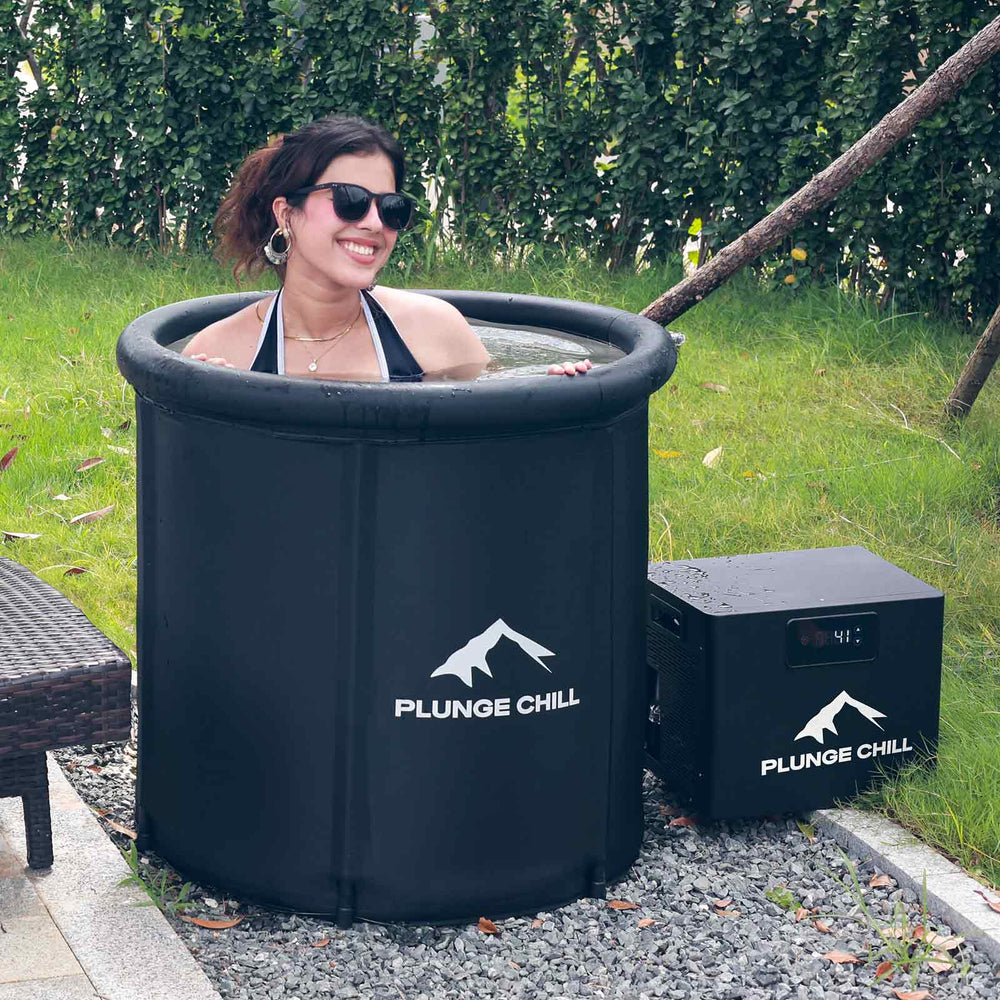
Plunge Chill Cold Plunge Chiller

Price: $499

Introducing the built-in Cold Plunge Chiller by Plunge Chill — with a 600W compressor, built-in pump & filtration. Erase fatigue, reignite energy, and dissolve post-workout soreness with targeted cold therapy. No ice. No setup. Just effortless recovery. Learn More

Plunge Chill Cold Plunge Chiller

How to Build a Cold Plunge Setup Under $800

Step 1: Choose a Tub

This is gonna be your second biggest expense after the chiller, so choose wisely.

You've got a few solid options:

Inflatable cold plunge tubs – The popular round ones everyone's using. Easy to set up, portable, and designed for this exact purpose.

Stock tanks – The classic galvanized steel or plastic troughs from the farm supply store. They're cheap, indestructible, and hold a ton of water.

Converted chest freezers – The ultimate DIY move if you're feeling ambitious. People turn these into insulated cold plunge tanks, but it requires more work.

Typical price range: $80 – $300

Recommended Inflatable cold plunge tub

Plunge Chill Cold Plunge Tub

Price: $89

Inflatable cold plunge tub

Step 2: Install a Water Pump

You need something to push water through the chiller. Without a pump, your chiller's just an expensive paperweight.

Most setups use:

Submersible water pumps – Easy to find, easy to set up. Just drop it in the water and go.

Flow rate around 500–900 GPH – That's the sweet spot for budget chillers. Too much flow and the chiller can't keep up; too little and it's not efficient.

Typical price: $30 – $60

Step 3: Connect the Chiller

This is where it all comes together. You're basically creating a continuous loop that cycles water through the chiller and back into your tub.

The flow looks like this:

Pump → Chiller inlet → Chiller outlet → Back to the tub

Use simple tubing—garden hose works, but vinyl tubing with hose clamps is more reliable. The water flows out of your tub, into the pump, through the chiller where it gets cold, and then dumps back in.

Let that run for a few hours and you've got a properly cold plunge without a single bag of ice.

Pro tip: Make sure your chiller outlet is positioned so the cold water circulates back into the tub instead of just getting sucked right back into the pump.

Step 4: Add Filtration (Optional)

Adding a small filter helps keep water clean and reduces maintenance.

This is especially useful if you plan to use your cold plunge several times per week.

How Much Money a Chiller Saves Compared to Buying Ice

A lot of people start out cold plunging the simple way: buy a tub, fill it with water, dump in a bunch of ice. And hey, it works. You get cold. You get the benefits. No arguments there.

But here's what creeps up on you—the ice bill.

Typical ice usage per session: 60–100 pounds
Average cost per session: $5 – $10

Doesn't sound terrible until you run the numbers.

If you're plunging 3–4 times a week (which is pretty standard once you're hooked), you're looking at:

$800 – $1,500 per year on ice.

Let that sink in for a second.

That means if you go the ice-only route for a couple years, you could've just bought a chiller with that money and been done with it. Actually, worse than that—you could've bought a chiller and had money left over.

So yeah, a chiller feels like an upfront expense. But when you look at what you're spending on ice over the course of a year? It's not an expense. It's an investment that pays for itself in 12 months, give or take.

After that? Every plunge is basically free. Well, minus the pennies in electricity. But compared to handing over a $10 bill to the corner store every other day? No contest.

Takeaway

With a little research and some basic DIY know-how, an affordable cold plunge chiller under $800 can absolutely deliver reliable cooling for a smaller tub or a homebuilt system. It might not have all the bells and whistles of a $5,000 unit, but you know what? It gets cold. And that's really the only job it needs to do.

Budget chillers shine brightest for:

Beginners who want to try cold therapy without taking out a loan

DIY builders who don't mind piecing together their own system

Small to medium tubs where lower horsepower units can actually keep up

And here's the kicker—if you're someone who actually sticks with cold plunging, a chiller pays for itself. No kidding. When you do the math on what you'd spend on ice over a year, the chiller isn't an expense. It's the smarter financial move.

FAQs

What is the cheapest way to build a cold plunge?

Honestly? The most budget-friendly route is pairing an inflatable tub with a small water pump and a 1/4 or 1/3 HP aquarium chiller. It's the combo that keeps popping up in DIY circles for a reason—it works. You can usually piece together a full system for somewhere in the $500–$800 range, which is less than some people spend on ice in a year.

Can an aquarium chiller cool an ice bath?

Yeah, absolutely. This is actually a pretty common move. People have been adapting aquarium chillers for ice baths for years, and they get the job done. The only real difference is speed—they'll take longer to bring the temperature down compared to a dedicated cold plunge chiller. But once it's cold? It stays cold.

How cold can a budget cold plunge chiller get?

Most of the affordable ones will get you down to that 39°F to 50°F range, which is exactly where you want to be. 39 is properly cold—like, "okay this is serious" cold—and 50 is still plenty uncomfortable (in the good way) for most people, especially when you're starting out.

What size chiller do I need for a cold plunge tub?

If your tub is in that 80 to 120 gallon sweet spot, a 1/3 HP chiller is your move. It's got enough power to handle that volume without struggling. If you're running something bigger than that? You're probably looking at 1/2 HP or more. The good news is most personal plunge setups fall right in that 80–120 range. Recommended 1/3 Cold Plunge Chiller with 80 to 120 gallon Cold Plunge Tub

1/3 Cold Plunge Chiller with 80 to 120 gallon Cold Plunge Tub

Is it cheaper to use a chiller or buy ice?

Over time? Not even close—the chiller wins. When you actually run the numbers, buying ice 3–4 times a week can easily hit $800–$1,500 per year. That means a chiller effectively pays for itself within 12 months. After that, every plunge costs you pennies in electricity instead of a fistful of dollars at the grocery store.


This site is protected by hCaptcha and the hCaptcha Privacy Policy and Terms of Service apply.