


Cold plunge safety refers to the practices that make cold water immersion safe and effective. These include maintaining safe water temperatures, limiting exposure time, ensuring proper sanitation, and using a reliable cold plunge tub with filtration and temperature control.
This guide translates standards and research into clear, actionable advice so you can select a cold plunge tub that is safe for your home or facility and effective for recovery.
Table of Contents ▲
- What “Approved” Means for Safety & Standards
- Safety Standards & Public Health Guidelines
- Safety Compliance Checklist for Buyers
- Product Categories & Safety Implications
- Safe Temperature and Duration Guidelines
- Water Safety and Sanitation
- Installation: Space, Power, and Setup
- Real-World Performance vs Product Claims
- Care and Maintenance for Hygiene
- Cold Plunge Buying Guide
- Key Takeaways
- Frequently Asked Questions (FAQ)
- Reconciling Conflicting Advice
- References
What “Approved” Means for Cold Plunge Safety and Standards
In residential settings, “approval” centers on electrical safety, water treatment suitability, slip and entrapment prevention, and clear operating guidance.
In commercial or team-use settings, approval also includes alignment with environmental public health rules that govern water treatment, filtration turnover, and physical safety features.
Electrical safety begins with third-party certification and ground-fault protection. A credible plunge uses a standard 110 V outlet with a built‑in or supplied GFCI, properly grounded components, and ETL or UL–listed plugs and cords.
Units such as Fire Cold Plunge advertise ETL/UL–certified cords, GFCI extensions, surge protection, and a physical power button to de-energize the system when servicing. This is the type of hardware stack I look for when placing a tub in an athlete training space.
Sanitation Baseline: Single-user home setups can rely on high-flow filtration with supplemental ozone/UV. Multi-user or commercial setups mandate a persistent residual disinfectant (chlorine or bromine) to stop biofilm buildup.
Mechanical safety includes a secure, lockable lid (especially in homes with children), non-slip ingress/egress, and anti-entrapment design on any suction or return.
Many state and provincial frameworks define or require anti-entrapment features comparable to pool and spa regulations. While smaller, stand‑alone tubs may not be explicitly captured in every jurisdiction, adopting these controls is a prudent risk reduction step.
Operational policies matter as much as hardware. At minimum, a facility should document water chemistry targets, temperature ranges, occupant screening, cleaning schedules, and emergency procedures.
Even for home users, the basics—testing water, keeping a log of filter changes and water replacement, and posting a simple pre-use checklist—prevent most avoidable issues.

Cold Plunge Safety Standards and Public Health Guidelines
In the absence of a single nationwide cold plunge standard, regulators often apply pool and spa definitions. The North Carolina Administrative Code classifies “spas” to include hot or cold water units not drained between users, which flags them for the same safety and sanitary controls typically seen in hot spas.
The Model Aquatic Health Code treats cold water as part of the spa definition and specifies circulation turnover not to exceed roughly an hour for public facilities.
The Cold Water Paradox: Cold slows bacterial growth, but it also slows down chemical kill rates. Pathogens like E. coli survive at 39°F, meaning your filter turnover and sanitizer must work harder, not less.
State and campus rules provide concrete examples. California limits public cold plunges to compact footprints and shallow depths and requires refrigeration and circulation comparable to hot spas.
At UC Davis, an Environmental Health Specialist inspects pools and spas, and the athletics therapy facility runs a cold plunge around 50–54°F for rehab, underscoring that institutional compliance is feasible and routine when the correct systems are in place.
Cold Plunge Safety Compliance Checklist for Buyers
| Safety/Compliance Area | What It Means | Why It Matters | What to Check Before Buying |
|---|---|---|---|
| Electrical certification and GFCI | ETL/UL–listed cords and components; GFCI protection on 110 V | Reduces shock and fire risk in wet areas | Labeling on cord and control box; included GFCI extension; grounded plug; manual power button |
| Circulation and filtration | High-flow pump with fine particulate capture | Prevents cloudy water and biofilms | Claimed turnover rate at or under an hour for multi-user; filter spec and maintenance access |
| Disinfection method | Residual sanitizer for multi-user; supplemental ozone/UV for homes | Continuous kill, not just clarity | Ability to maintain chlorine/bromine residual if shared use; test-strip targets and logs |
| Anti-entrapment and return design | Suction safeguards or unblockable drains | Prevents hair/body entrapment | Suction cover design; safety vacuum release features if present |
| Surfaces, ingress, and lids | Non-slip steps/floor; lockable or weighted lid | Prevents slips and unauthorized entry | Integrated tread, grab points, and lockable hard-top options |
| Temperature control and stability | Integrated chiller with thermostat control | Predictable dosing; no ice runs | Verified low-temperature setpoint near 40°F; heat capability if doing contrast |
| Documentation and support | Clear manual, warranty, service network | Faster resolution of issues | Warranty length; filter availability; tech support responsiveness |
This checklist is how I vet units for teams and rehab settings. It applies equally well to home buyers who want fewer surprises after the first month.

Cold Plunge Chiller + Tub (MAX)
Cold Plunge Product Categories and Their Safety Implications
Not all cold plunge designs face the same risks. DIY tubs filled with bags of ice appeal on price but offer neither stable temperatures nor integrated filtration. With no recirculation or auto-disinfection, shared use becomes a drain-and-sanitize-each-time proposition. For single users at home, this can be workable if you accept the maintenance burden; for facilities, it is impractical.
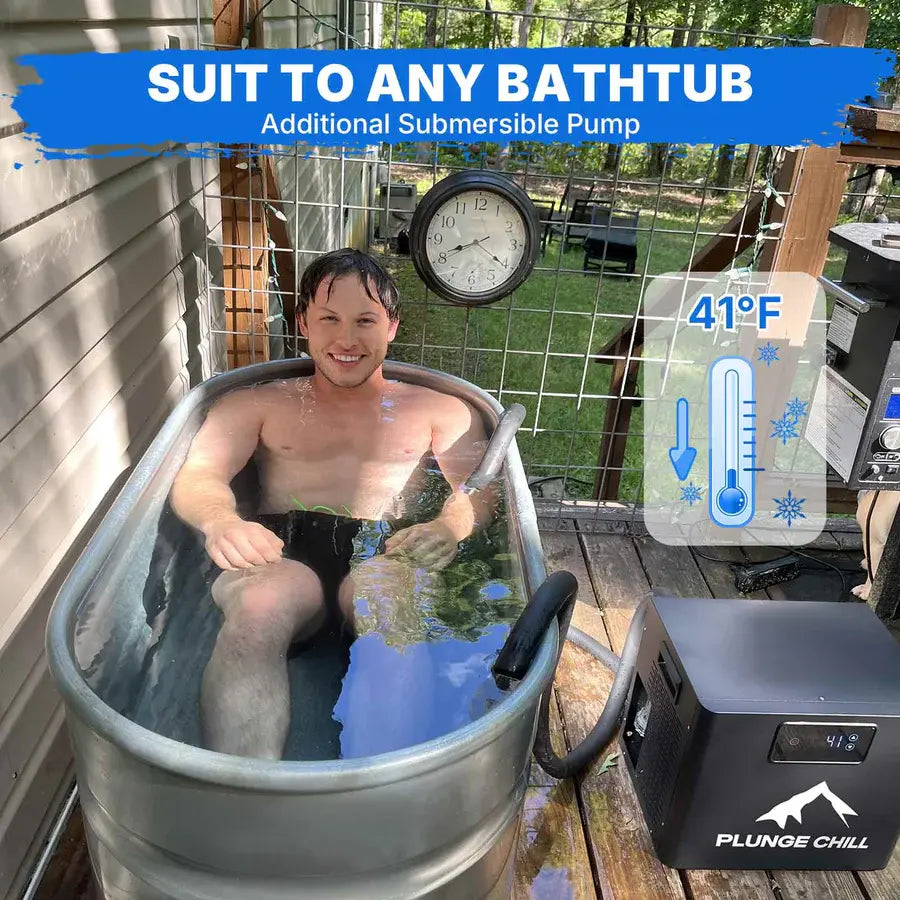
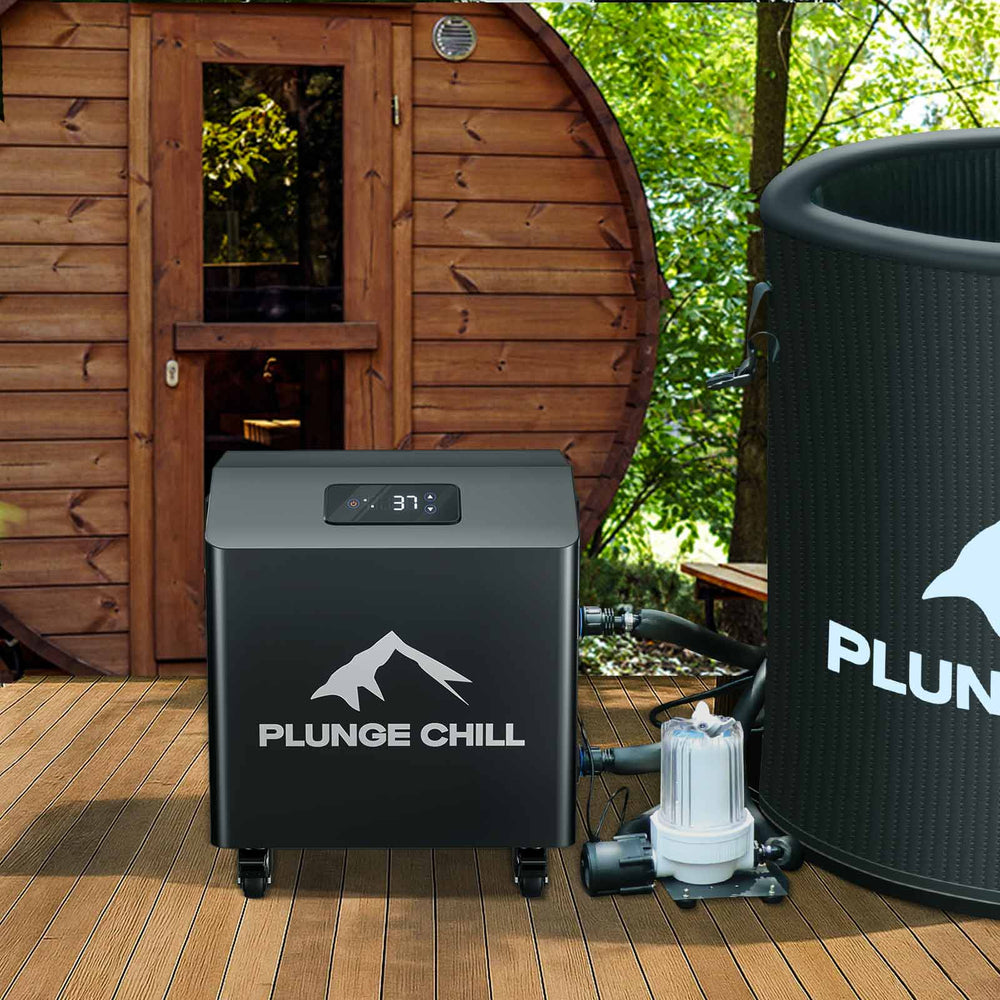
External chiller systems can cool quickly but introduce hoses, fittings, and floor clutter. Modular setups can be made safe, yet they demand attention to electrical protection, hose routing, and cleaning. Some buyers find the look and noise intrusive in compact rooms.
All-in-one internal compressor tubs—like the Fire Cold Plunge—integrate chiller, filtration, and controls inside a sealed cabinet. These systems are quieter, easier to place, and often cool into the 30s with precise thermostats.
When they also include ETL/UL–listed power components, supplied GFCI, and a lockable lid, they map cleanly onto the checklist above. In my experience, this category delivers the most predictable dosing and day‑to‑day reliability for most athletes.
Dual-zone hot and cold units enable contrast therapy, alternating heat and cold in the same session. For year‑round use or team rooms, this is efficient.
From a safety standpoint, ensure each zone has proper circulation and disinfection, and mind the physiological swings for at‑risk users, because large, rapid temperature changes demand tight supervision.
| Category | Cooling Control | Water Treatment | Electrical Safety | Regulatory Fit | Typical Use Case |
|---|---|---|---|---|---|
| DIY ice bath | Unstable; manual ice | None unless added; drain-and-clean | Varies; often not integrated | Poor for shared use | Budget home, single user, short-term trials |
| External chiller + tub | Good; fast pull-down | Filtration depends on kit; may add UV/ozone | Must ensure GFCI and safe hose routing | Acceptable if built to spa standards | Flexible spaces; tinkerers |
| All-in-one internal compressor | Precise; quiet; stable low 40s to 30s | Built-in filtration; often ozone; easy filter access | Often ships with GFCI and certified cords | Strong for home; adaptable to supervised facilities | Home gyms; training rooms |
| Dual-zone hot/cold | Separate thermostats | Separate or shared systems | More circuits, more controls | Facility-friendly if documented | Contrast therapy and team settings |
Safe Cold Plunge Temperature and Duration Guidelines
Evidence-informed dosing protects health and preserves training adaptations. Most people begin around 59°F and progress toward 40–55°F as tolerance improves. Brief exposures are safer and just as effective for many goals.
Community guidelines and clinic sources recommend starting with 30–60 seconds and building to a few minutes per session; a typical steady-state for many athletes is about three to five minutes per plunge.
The 11-Minute Rule: Target roughly 11 minutes total per week, split across 2–4 sessions (Dr. Susanna Søberg). Prioritize consistent brief dips over risky marathon plunges.
The training context matters. Mayo Clinic Health System notes frequent cold immersion immediately after resistance training may blunt hypertrophy signaling and strength gains, while endurance adaptations appear largely preserved.
For lifters in strength cycles, I schedule cold exposure away from the immediate post-lift window or on different days, then lean into post‑event use during competition phases when recovery trumps growth.
The American Lung Association further cautions that cold shock can provoke rapid breathing and increase risk for those with chronic lung conditions, and that mixing heat and cold raises cardiovascular load. In practice, I screen for cardiovascular or respiratory conditions, ensure supervision for early sessions, and avoid contrast therapy with at‑risk populations.
Cold Plunge Water Safety and Sanitation
It is easy to assume cold water is clean water. Environmental public health reviews show the opposite. At about 39°F, cold slows microbial growth but also reduces the effectiveness of disinfectants.
Protozoa such as Cryptosporidium are not removed by typical 20‑micron filters, and biofilms protect microbes from exposure.
For multi-user recirculating systems, relying solely on ozone or UV is insufficient; guidance aligned with the CDC’s Model Aquatic Health Code recommends maintaining a measurable residual of chlorine or bromine to prevent biofilm formation and provide continuous disinfection.
For stand‑alone tubs without recirculation in spas or clinics, a conservative approach is to drain, clean, and disinfect between users, then document the process.
Core Sanitation Rules: Enforce a 1-hour turnover rate, verify chlorine/bromine residuals with test strips, and mandatorily require pre-plunge showers to cut chemical demand in half.
For home users, a balanced approach suffices. A high-flow filter with ozone keeps water clear between periodic changes, as long as you skim after sessions, hose-rinse filters weekly or biweekly, replace filters every few months, and change water every month or two depending on use.
If several family members use the plunge daily, maintain a small chlorine or bromine residual and confirm it with test strips; the cold slows chemistry, so verify rather than assume.

Cold Plunge Installation Requirements: Space, Power, and Setup
Cold plunge tubs should be placed on a flat, stable surface with straightforward drainage. A standard 110 V outlet on a GFCI protected circuit is typical for modern all‑in‑one units, and many run under three amps once temperature stabilizes.
Clear the manufacturer’s minimum footprint for serviceability and safe entry and exit; for example, some reclined acrylic units need around 70 by 32 inches of clearance to open lids and step in safely.
If installed outdoors, shade the unit and avoid direct sun to reduce heat load and prevent UV damage. Many internal compressor tubs do not require complex winterizing and can operate well below freezing under a cover, but verify with your manufacturer and avoid exposing cords and fittings to ice loads.
Structural Weight Alert: A filled tub easily surpasses 1,000 lbs. If placing on a patio, deck, or second floor, confirm floor load ratings before filling with water.

Cold Plunge Real-World Performance vs Product Claims
Product marketing often emphasizes extreme cold, app control, or eye‑catching finishes. As a reviewer, I map claims onto the compliance checklist.
Fire Cold Plunge, for instance, advertises a stable low setpoint near 32°F, hour‑class filtration turnover, ETL/UL–listed power components with a GFCI extension, an ergonomic reclined liner, and a lockable hard‑top lid.
Chilly GOAT Tubs highlights integrated chillers down to about 40°F, heating to roughly 104°F for contrast work, and attention to non‑slip flooring and jet design to reduce thermal layering. Those are meaningful for both safety and user experience.
One overlooked dynamic is that “colder” is not always “better.” Most recovery benefits appear in the roughly 50–59°F range, and dropping into the 30s mainly reduces session time and raises cold-shock risk. Chilly GOAT’s own education suggests starting warmer and progressing, which I endorse.
A second nuance is sanitation at low temperature. Public health sources note that cold slows disinfectant kinetics, not just bacteria. If your tub runs near 40°F, you may need more circulation time and diligent brushing to prevent biofilms, even if the water looks pristine. That is why I specify test-strip checks and a cleaning log in multi-user settings.
Fringe Claims Reality Check: Marketing claims like “structured water” or gemstone filters lack rigorous peer-reviewed evidence. Always ask for independent lab microbial data before paying a premium.
Cold Plunge Care and Maintenance for Safety and Hygiene
Daily habits drive outcomes. After each session, skim debris and confirm that the cover is fully seated.
Weekly, hose-rinse the filter, wipe the waterline, and glance at the cord and GFCI for damage. Every month or two, replace the filter and change the water depending on use and sanitizer strategy.
Many manufacturers include ozone-compatible cleaning agents to reduce reliance on heavy chemicals,that works for single-user homes but does not replace chlorine or bromine where multiple users share water.
Operating costs are straightforward and budgetable. A realistic example from all‑in‑one compressors is roughly $15–30 per month in electricity for steady operation at cold settings, with filter replacements under $30 every few months, plus optional additives. Make sure replacement filters are easily sourced, and confirm warranty support covers the compressor and control box, not just the shell.

Cold Plunge Water Filter Upgrade
Cold Plunge Buying Guide: Recovery and Safety Perspective
Start with fit and use cases. Taller athletes need shoulder‑depth immersion without contorting; reclined liners with footrests sustain posture so that the “hard part” remains the water, not the position.
Verify that your target temperature is reachable and stable in your climate, and that controls are intuitive. For contrast therapy, confirm heat capability and the safety of rapid transitions for your population.
Evaluate maker credibility, parts availability, and service responsiveness. Independent roundups and lab-style reviews provide useful comparative data, but always cross‑check specs and warranties on the manufacturer’s current documentation; discrepancies between tables and text are common as models iterate.
Buyer Priority Summary: Home users should favor all-in-one ETL/UL-listed compressors with lockable lids. Facilities should demand sub-1-hour turnover, documented SOPs, and accessible replacement filter supplies.

1HP Cold Plunge Chiller + Tub(Pro)
Key Takeaway
Safety compliance is not a sticker; it is a system that integrates certified electrical components, thoughtful mechanical design, and water treatment aligned with public health guidance. The simplest path to an “approved” cold plunge experience at home is an all‑in‑one compressor unit that runs on a GFCI‑protected 110 V outlet, includes a lockable cover, and provides high‑flow filtration with clear maintenance guidance.
In facilities, layer in documented operating procedures, residual disinfectant for shared water, and oversight from environmental health professionals. Set temperatures and dosing to match your goals and athlete profile, and remember that colder is not automatically better—safer, consistent exposures deliver better outcomes over time.

Frequently Asked Questions (FAQ)
What does “approved” mean for a cold plunge tub?
In residential contexts, it means the unit uses ETL/UL–listed power components with GFCI protection, provides stable temperature control, includes non‑slip ingress and a secure cover, and documents filtration and sanitation.
In facilities, it also means aligning with pool and spa rules that govern turnover, residual disinfectant, and anti‑entrapment, as seen in the Model Aquatic Health Code and state definitions that classify cold-water spas alongside hot spas.
Is ozone or UV alone good enough for multi‑user sanitation?
No, not for shared, recirculating water. Public health guidance indicates UV and ozone are effective adjuncts but do not replace a measurable residual of chlorine or bromine that continuously protects against biofilms and microbes. For stand‑alone, non‑recirculating tubs used in clinics, draining and disinfecting between users is the conservative approach.
What temperatures and times are safest to start with?
Most beginners do well starting near 59°F and keeping immersions short, then progressing toward 50–55°F and eventually the low 40s as tolerated. Early exposures of 30–60 seconds are sufficient, building to a few minutes per session. A weekly total of roughly eleven minutes across several sessions is a pragmatic goal supported by field practice and expert recommendations.
Can cold plunges hurt my strength gains?
Frequent cold immersion immediately after resistance training can blunt anabolic signaling and long‑term hypertrophy. For strength development, schedule cold sessions away from the immediate post‑lift window or on off days. Endurance adaptations are less affected, so runners and cyclists often use cold more liberally after key efforts.
Are claims about “structured water” or gemstones credible?
Evidence remains limited. Suggested verification step: request independent laboratory reports that measure microbial control and physiologic outcomes with and without the claimed technology and have a clinician or exercise physiologist review them before purchase.
Are cold plunge tubs HSA/FSA eligible?
Some brands advertise eligibility for qualified customers. Eligibility varies by plan and documentation. Suggested verification step: contact your benefits provider with a product invoice and a physician’s note outlining therapeutic intent to confirm coverage before purchasing.
A Note on Conflicting Advice and How to Reconcile It
Consumer-facing blogs sometimes suggest longer sessions of ten to fifteen minutes at colder temperatures, while clinical and public health sources prioritize shorter durations, supervision, and clear sanitation protocols. Differences usually stem from definitions of “cold,” user populations, and objectives.
A safe synthesis is to dose conservatively at first, progress gradually, and match the sanitation strategy to your user volume and water temperature, remembering that cold reduces disinfectant speed. The net effect is a program that respects physiology and keeps your water—and your athletes—safer.
By anchoring purchases and protocols to the compliance checklist and the clinical evidence on dosing and sanitation, you can confidently implement cold-water immersion at home or in a facility without compromising safety or outcomes.
References
- https://www.academia.edu/43168954/Health_and_Safety_Technical_Guide
- https://www.law.cornell.edu/regulations/north-carolina/15A-N-C-Admin-Code-18A-2508
- https://safetyservices.ucdavis.edu/units/ehs/pool-spa-safety/pool-spa-listing
- https://admisiones.unicah.edu/uploaded-files/FvYHkD/1OK025/benefits__of_hot_cold-therapy.pdf
- https://health.clevelandclinic.org/what-to-know-about-cold-plunges
- https://www.browardhealth.org/blogs/health%20benefits%20and%20risks%20of%20cold%20plunges
- https://www.lung.org/blog/sauna-cold-plunges-health-impacts
- https://www.mayoclinichealthsystem.org/hometown-health/speaking-of-health/cold-plunge-after-workouts
- https://www.garagegymreviews.com/best-cold-plunge-tub
- https://therafrost.com/?srsltid=AfmBOorWlq7gVW4jNvoj5OV98E9_SP4WNpXZTcYh4oH8c-b83J3IZuGH






Leave a comment