Backyard Oasis: Designing the Perfect Outdoor Cold Plunge Area (2026 Edition)

Backyard Oasis: Designing the Perfect Outdoor Cold Plunge Area (2026 Edition)

Cold plunges have gone from fringe recovery ritual to mainstream backyard feature. As a sports rehabilitation specialist, strength coach, and cold plunge product reviewer, I see it from both sides: athletes using them to manage heavy training loads, and homeowners trying to turn a patch of lawn into a functional, spa-like recovery zone.

Designing that “backyard oasis” is not just about picking a stylish tub. It is about taking the emerging science of cold water immersion, your training goals, and the realities of your yard, and translating all of that into a layout you will actually use in January, not just post on social media in July.

This 2026 edition walks through the key decisions: what you want from cold exposure, which type of plunge makes sense, how to site and build around it, and how to use it without sabotaging training or risking your health.

Start With Your Goal: Why Are You Cold Plunging?

Before you pour concrete or order a chiller, get clear on what you want the plunge to do for you. The right design depends heavily on whether you are chasing faster recovery between sessions, better stress resilience, or simply a ritual that bookends your day.

Cold plunge therapy is typically defined as brief immersion in water about 39–60°F. Several wellness-focused manufacturers describe most “everyday” plunges sitting around 50–59°F, with early sessions lasting one to three minutes and progressing toward five to ten minutes as tolerance improves. That pattern appears consistently in wellness guides from brands that build backyard cold plunges and in DIY cold plunge pool resources.

From a health and performance perspective, large medical centers are more cautious. Reviews from academic groups such as Case Western Reserve University and Harvard Health point out that most claimed health benefits are supported by small studies or anecdote. There is reasonably consistent evidence that cold water immersion can blunt acute inflammation, reduce soreness, and temporarily increase metabolic rate. There are also controlled trials, summarized by Stanford’s lifestyle medicine group, showing short-term improvements in mood and stress markers after deliberate cold exposure.

What is not well established is long-term disease prevention or dramatic “immune boosting.” The best that current evidence supports is a mix of modest short-term improvements in stress, sleep, and perceived well-being in some users. So the primary reasons I recommend cold plunges in a sports setting are practical: manage soreness during congested competition schedules, optionally support mood, and build mental resilience, not to treat chronic disease.

A simple example may help. Suppose you are a recreational athlete training four days per week and you plan to plunge three times weekly for about four minutes per session at 50–55°F, similar to protocols promoted by some recovery-focused pool builders. Including walking to the plunge, drying off, and rewarming, the total time investment is often about ten minutes per session, which matches reports from DIY builders who can complete a five-minute immersion inside a ten-minute total routine. That means roughly thirty minutes per week of extra time. Designing your backyard layout so that this ten-minute block is frictionless is crucial; otherwise, the plunge quickly becomes an expensive ornament.

Recovery, Strength, and Timing

For strength and hypertrophy, timing matters more than most people realize. Sports medicine departments at institutions such as Ohio State University and Mayo Clinic have highlighted research in which regular post-workout ice baths reduced long-term gains in muscle size and strength. The mechanism is straightforward: cold blunts some of the inflammatory and molecular signaling that drive adaptation after resistance training.

That does not mean cold plunges are “bad” for lifters. It means you should not routinely sit in 50–59°F water immediately after every heavy session if your primary goal is muscle growth or maximal strength. In my own practice with power athletes, I typically push cold exposure to the next day or at least twenty-four hours after key strength work, while being more flexible after long endurance sessions or tournament play where next-day readiness is the priority.

If your priority is mental health and stress resilience rather than maximal strength, the calculus is different. Stanford’s review of cold water immersion and mental health shows that regular sessions over weeks can lower baseline cortisol responses to stress while maintaining strong noradrenaline responses, a combination associated with improved stress tolerance. In that setting, shorter daily exposures at moderate cold can be reasonable, provided medical screening is clear.

Safety Baselines for Healthy Adults

Across multiple medical sources, a few “guardrails” are fairly consistent for otherwise healthy people.

Typical safe water temperatures for newcomers cluster around 50–60°F, with more extreme 39–45°F left to experienced users who understand their responses. Several hospital-based sports medicine and cardiology services recommend starting with thirty to sixty seconds and slowly working up to several minutes, staying well under ten minutes per plunge for most users. When full-body immersion at 50–59°F is used specifically for recovery, common protocols in university sports medicine materials suggest about ten to twenty minutes, but those are usually supervised and carefully screened.

A practical guideline I give athletes in good health is simple. Start warmer and shorter than you think, for example one to three minutes around the mid to upper 50s, and progress just one variable at a time: either reduce temperature slightly or add a minute, not both. Your backyard design should make it easy to abort a session, stand up, and get warm quickly if anything feels off.

Choose Your Form Factor: Tub, Plunge Pool, or Something In Between?

Once your goals and protocols are clear, the next decision is physical form. Backyard cold plunges fall roughly into three categories: portable or barrel-style tubs, self-contained above‑ground units, and in‑ground plunge pools.

Manufacturers and DIY resources define these differently, but the distinctions are helpful when you plan space, cost, and infrastructure.

Portable, Barrel, and Inflatable Setups

Portable solutions include inflatable plunge tubs, collapsible insulated frame pools, and compact ice barrels. Design articles from cold plunge brands describe these as ideal for smaller spaces, seasonal use, and for users who want easy relocation or storage. A typical one-person plunge tub is roughly 67 inches long, about 31.5 inches wide, and around 24 inches tall, while an “XL” tub for multiple users might be about 73 by 32.5 by 27 inches. Those dimensions sit comfortably on a small deck or a reinforced concrete pad.

DIY sources point out the tradeoffs. Ice barrels, inflatable tubs, and metal stock tanks are easy to obtain and relatively inexpensive, but most lack insulation, lids, integrated chilling, or built-in filtration. Without those, you end up buying large quantities of ice or frequently dumping and refilling the water. Stock tanks in particular act like heat sinks; in warm climates they can pick up heat rapidly, making it harder to hold water in the 40s or 50s without a substantial chiller and added insulation.

These options make sense if you are testing whether cold plunging fits your life, if you have limited space, or if you are willing to accept more manual work to control temperature and water quality.

Above-Ground Dedicated Cold Plunge Units

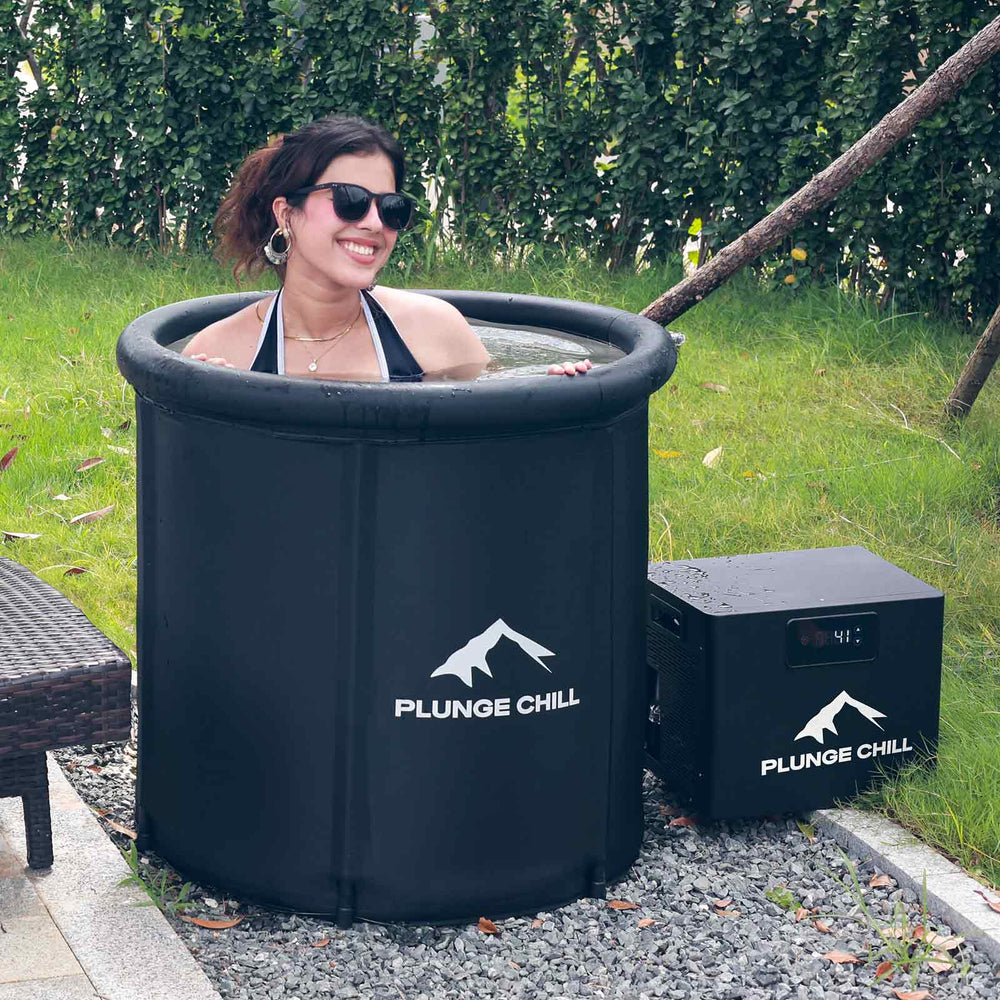
Above-ground dedicated cold plunges look like compact hot tubs but run in reverse. They typically include a molded tub, integrated pump and filtration, and a dedicated chiller to hold water in the desired temperature range. Design guides and product reviews describe wooden barrel-style tubs that suit rustic aesthetics and stainless steel or acrylic tubs that work well in minimalist, modern yards.

From a cost perspective, independent reviewers have highlighted several popular units in the roughly $2,800 to $6,900 range for a one- to two-person tub with built-in chilling, depending on brand and insulation quality. Strong insulation and tight covers are not just comfort features; they materially reduce how often the chiller runs and how much energy you pay for. In practice, that determines whether your plunge is a sustainable daily tool or a guilty-pleasure line item on the power bill.

The advantage of this category is simplicity. For many units, you provide a level pad, appropriate electrical service, and water, and the system handles the rest. Compared with DIY builds, you get a warranty, standardized plumbing parts, and customer support, which matters when a chiller fails in the middle of your season.

In-Ground Cold Plunge Pools

A DIY cold plunge pool, according to builders who specialize in them, is a small, spa-like, permanently plumbed pool with a pump, filter, and dedicated chiller, not just a barrel with ice. More general plunge pool guides describe typical lengths of about 6–12 feet with uniform depths around 4–7 feet, holding roughly 5,000–10,000 gallons, far less than a full-size pool but vastly more than a small cold plunge tub.

Construction methods vary. Some builders favor poured-form concrete walls with heavy bracing. Others use cavity walls built from two runs of concrete block with a filled and reinforced core that can hide plumbing and insulation. Hollow concrete block walls with rebar tied into a poured base are a popular middle ground. Insulating concrete form (ICF) blocks, which act like interlocking foam “Lego” forms that stay in place, give you structure and permanent insulation at the same time, although they typically cost more.

Cost estimates from plunge pool specialists place basic plunge pool projects in the neighborhood of 55,000 for simpler installations, with concrete or premium custom projects ranging much higher into the 90,000 range. Another technical site focused on plunge pools suggests that even more compact units commonly run around 60,000 or more once you add installation, fencing, and automatic covers.

That is a major capital project, but the result can become a focal point of the yard, adding to property value while serving for both cold plunges and warm-weather lounging, depending on how you configure the equipment.

Quick Comparison of Backyard Cold Plunge Types

Type

Approximate Water Volume

Typical Upfront Cost (USD)

Setup Complexity

Best Suited For

Portable barrel or inflatable

Roughly 80–150 gallons

About 1,000 for tub and pump

Low to moderate

Renters, first-time users, seasonal setups

DIY insulated cooler or stock tank

Around 100–200 gallons

Around 1,700 for cooler build; under about $1,000 for simple stock tank plus pump

Moderate to high (DIY skills required)

Frequent users who enjoy projects and hands-on maintenance

Prefabricated above-ground plunge tub

Roughly 80–150 gallons

About 6,900+ depending on brand and insulation

Moderate (pad and proper electrical)

Athletes and families wanting plug-and-play reliability

In-ground plunge pool

Roughly 5,000–10,000 gallons

About 60,000+ depending on materials and features

High; often professional build

Long-term homeowners integrating pool into landscape

The ranges above pull directly from DIY cost breakdowns, plunge pool industry guides, and product reviews. They illustrate why it is crucial to align your ambitions with budget and time. A well-built $1,700 cooler-based plunge can deliver similar water-quality and temperature performance to some 5,000 prefabricated tubs, while a concrete plunge pool is closer to a full backyard remodel than a fitness gadget.

DIY Versus Turnkey: How Deep Into the Build Should You Go?

If you are comfortable with tools and systems, building your own plunge can be rewarding and cost-effective. If not, some aspects are still worth understanding so you can ask the right questions of contractors and manufacturers.

The Insulated Cooler or Stock Tank Approach

One of the more technically thoughtful DIY builds on record uses a large, ultra-insulated hunting cooler as the tub. In that project, a roughly 400–450 quart cooler holding about 105 gallons is paired with an external pump, filter, and chiller. The total system cost landed around $1,700, roughly $1,300 less than a comparable ready-made cold plunge at the time.

The physics of why this works are straightforward. With thick insulation and a tight-fitting lid, the cooler design reported chilling water at about 2°F per hour. At an operating temperature around 40°F with ambient air near 75°F, the water warmed only about 1–2°F per day when the chiller and pump were off. That means once the tub is at temperature, energy use drops significantly because you are maintaining, not repeatedly pulling a large thermal mass down from warm ambient.

Chiller sizing is where many DIYers go wrong. In the cooler build above, a 1/4 horsepower chiller, often available for under about $600, was sufficient thanks to the excellent insulation. In contrast, poorly insulated steel stock tanks often require at least a 1/2 horsepower or even 1 horsepower chiller. One reader of that build reported that their 1 horsepower chiller ran almost constantly when cooling a stock tank but less than an hour per day after they switched to an insulated cooler of similar volume. That difference shows up on your power bill every month.

Stock tank conversions, described in detail by DIY property and pool resources, remain attractive because an eight-foot diameter galvanized tank may cost only a few hundred dollars. Adding an above-ground pump and filter system for roughly 500 can yield a usable plunge under about $1,000 before you even consider a chiller. However, to make such a setup feel like an oasis, you must address insulation, safe steps or a surrounding deck, and screening the agricultural look of the tank. Many homeowners end up building a wood deck around the tank to hide the metal walls and create safer access, which adds cost and complexity.

Concrete, Block, and ICF DIY Plunge Pools

For in-ground cold plunge pools, several DIY-oriented pool builders strongly emphasize that planning and structure are everything. Recommended methods for competent DIYers include concrete block walls tied to a poured base, with rebar reinforced cores filled with concrete, or cavity wall systems using two block runs with a concrete-filled cavity that houses plumbing and insulation. ICF blocks offer a more user-friendly route because a single person can assemble them, and they provide structure plus insulation in one system.

The plumbing layout for these pools is more sophisticated than a small tub: at least two suction drains, two return inlets, a pump, a filter, and a dedicated chiller plumbed in a loop to deliver continuous water turnover and cooling. Some guidance suggests planning a dedicated “control room” or equipment area adjacent to the pool where pump, filter, heater or chiller, and electrical components are accessible and ventilated.

Even experienced DIYers are encouraged by pool-building guides to bring in licensed professionals for electrical work, and often for critical plumbing connections, both for safety and for code compliance. In practical terms, once you tally excavation, concrete, reinforcement, tiling, and equipment, your total cost profile resembles the plunge pool ranges mentioned earlier rather than a weekend project.

When a Prefabricated Unit Makes Sense

There are good reasons elite athletes, teams, and many busy professionals opt for prefabricated plunges or plunge pools. Modern container-style plunge pools built from steel shells with insulated walls and engineered membrane interiors offer rapid installation, often in a matter of hours for above-ground placements. Some brands deliver walls rated around R‑10 with high-tensile liners and integrate commercial-grade automation for chemical monitoring, temperature control, and even energy-use tracking.

When evaluating prefabricated units, think like a reviewer rather than a fan. Prioritize structure and insulation first, then aesthetics. Questions worth asking include how thick the tub insulation is, whether the plumbing uses standard, easily replaceable fittings, and what the warranty looks like on both shell and equipment. Several plunge pool experts warn that focusing only on initial shell price can be misleading; once you add installation, permits, required fencing, and covers, a bargain shell can turn into a very expensive project.

A simple “back-of-the-envelope” comparison can clarify your own decision. Suppose you are looking at a $3,000 insulated prefabricated plunge tub versus a $1,700 cooler-based DIY build. The price difference is $1,300. If you value your own time at $50 per hour and expect to spend thirty hours planning, gathering parts, building, and troubleshooting the DIY system, that labor alone is effectively $1,500. At that point, the “cheaper” DIY option only makes sense if you enjoy the process and want the flexibility to modify and repair everything yourself.

Site Selection: Turning a Corner of Your Yard Into a Recovery Zone

With your hardware path chosen, you can turn to the actual backyard design. Here, principles from plunge pool and landscape design carry over directly: you need a site that is accessible, private enough to feel comfortable, technically feasible for utilities, and integrated with the rest of your outdoor living space.

Space, Access, and Utilities

Plunge pool planners recommend considering access for both people and equipment. Even a modest cold plunge tub requires a level, load-bearing surface and a way to bring the unit into the yard. Container-style plunge pools or precast shells may require crane access, which can dramatically increase cost if your yard is hard to reach.

For in-ground plunges, DIY and professional guides stress the importance of checking local codes, securing permits, and calling utility locating services before excavation. The plumbing layout, including skimmers and drains, should be designed before any digging. Many guides also emphasize allocating enough space for an equipment pad or small “control room” near the pool to house pump, filter, chiller, valves, and electrical panels. If you neglect this, you wind up with equipment scattered around the yard and difficult maintenance.

Water supply and drainage are practical details that shape the design. Plunge pool and hot tub resources remind owners that chemically treated water should not be used for watering plants. You will need a way to drain or backwash without flooding patios or lawns. Being within hose reach of an outdoor spigot simplifies topping off the tub after evaporation and splash loss.

Imagine a typical suburban yard where you dedicate a roughly 12 by 16 foot corner to the plunge area. A one-person tub with a footprint around 6 by 3 feet might sit against a privacy screen, leaving room for a small deck, a bench for towels and robes, and a narrow equipment pad tucked behind a screen panel. Reaching the tub from the back door might be a thirty-foot walk. That is short enough to be tolerable on a cold morning but long enough to keep chlorine or sanitizing odors away from indoor living areas.

Shade, Sun, and Microclimate

Cold plunge design articles routinely recommend placing the tub in a shaded or partially shaded area. Shade naturally helps keep water temperature down and tends to feel more serene. If your only viable spot is in full sun, you can compensate with an insulated cover and, in some designs, retractable shade sails or pergolas that limit direct solar gain during peak hours.

Wind exposure also matters. A windy corner will make getting in and especially getting out far more uncomfortable, which reduces compliance. Strategically placed evergreen shrubs, lattice panels, or pergolas soften wind without fully enclosing the tub.

Technical DIY guides for plunge pools and stock tank conversions suggest avoiding sites directly under shedding trees to reduce debris load, which in turn keeps filtration and water chemistry more manageable. Matching that advice with shade needs often means placing the plunge near but not under tall trees, or creating artificial shade with structures instead of relying on canopies that drop leaves.

Privacy, Safety, and Flow

Cold plunging is an intense, often vulnerable experience. You are scantily clothed, breathing hard, and not eager for an audience. Backyard design ideas from wellness-focused brands emphasize using tall plants, bamboo screens, fencing, pergolas, or pavilions to create a secluded, resort-like feel around the tub.

Safety is equally important. Plunge pool and small-pool design guides recommend non-slip decking, clearly defined steps or ladders, and adequate lighting along the path and around the water’s edge. For in-ground plunges, local codes may require fencing, self-closing gates, or specific barrier heights. Even for above-ground tubs, I encourage clients with children to treat the cold plunge as they would a spa: secure covers, clear rules, and, when appropriate, gate-controlled access.

Think about flow. After a frigid plunge, you do not want to navigate a long, dark path across wet stone while shivering. The most-used setups I see place the plunge a short, direct walk from the back door or from a home gym, with a bench or hooks immediately adjacent for towels, robes, and maybe a warm hat. These micro-details are where a backyard plunge transforms from something you use on weekends into a daily tool.

Designing the Oasis Experience Around the Plunge

Once the fundamentals are in place, you can layer in elements that transform a purely functional plunge into a backyard oasis that supports both recovery and lifestyle.

Hot–Cold Contrast: Saunas, Hot Tubs, and Showers

Many backyard cold plunge design guides highlight the pairing of a cold tub with a sauna or hot tub for contrast therapy. A dedicated wellness builder describes placing a sauna or home spa near the plunge so you can move quickly between hot and cold without long walks. Another DIY account of an at-home infrared sauna build illustrates how a serious home user might invest around $1,800 to create a sauna that would cost roughly three times that amount if purchased commercially.

From a rehab standpoint, contrast cycles can be useful for some athletes and for general relaxation, though, again, high-level evidence is limited. Practically, having a hot option nearby makes the entire routine more psychologically approachable, especially for family members who are less enthusiastic about icy water.

Outdoor showers also earn their place. Design articles recommend installing a simple rinse station next to the plunge, which lets you warm up slightly and rinse off sweat or chlorine before and after sessions. For home users, towel warmers and heated benches are small luxuries that pay off every single cold morning.

Lighting, Sound, and Surfaces

Experience-focused design ideas for cold plunges repeatedly mention underwater LED lighting, pathway lighting for safety, and weatherproof sound systems for music or guided breathing during sessions. Even indoor “home spa” bathroom remodels now integrate ceiling speakers to provide audio without clutter.

In an outdoor plunge area, I often recommend a combination of low, indirect pathway lights and one or two dimmable fixtures near the tub itself. Underwater LEDs are optional but can be powerful for mood and for making night plunges safer. The goal is enough light to move safely without turning the yard into a stadium.

Surface choices underfoot are critical when feet are wet and numb. Plunge pool designers favor materials like textured concrete, stone pavers, or composite decking with good slip resistance. Any wood deck around a tub or stock tank should use weather-resistant lumber and be built to code, with railings and self-latching gates where required.

Seating, Fire, and Recovery Furniture

Cold plunge design ideas from garden and pool brands emphasize adding plush, weather-resistant seating, fire pits, and heated benches to create a pre- and post-plunge relaxation zone. Built-in benches or lounge ledges around plunge pools also function as social space when the water is not at polar-bear temperatures.

From a recovery perspective, I want at least one stable bench or chair where an athlete can sit immediately after exiting the water. This is not the time for precarious barstools or low lounge chairs. A simple calculation: if you plan to spend four minutes in the water and another four to six minutes drying and rewarming, you will spend roughly half your “cold plunge time” on that bench. It is worth making it comfortable and sheltered from wind.

Small touches such as hooks for robes, a covered storage box for hats and gloves, and a basket for flip-flops make the space feel considered and reduce friction. These are details that turn a functional tub into a ritual space.

Programming Your Backyard Plunge Into Training and Life

Even the best-designed plunge area can be underused if you do not integrate it intelligently into your training and daily routine.

Temperature and Duration Guidelines in Practice

Synthesis of protocols from plunge pool guides, wellness brands, and hospital-based sports medicine services gives a practical picture for healthy adults.

For beginners, target water in the 50–60°F range and exposures of one to three minutes. Start closer to the warm end and shorter durations, especially if cold exposure is new to you. Over several weeks, if sessions feel manageable, you can gradually increase toward five to ten minutes or reduce temperature a few degrees, but not both at once.

More aggressive protocols used in some research settings, such as ten to twenty minutes in 50–59°F water, are generally supervised and should not be your starting point. Many brands that install cold plunge pools suggest that consistent practice three times per week totaling about ten to twelve minutes of cold exposure can be enough for most users to notice changes in mood and perceived recovery within a couple of weeks.

Remember that colder is not automatically better. Water in the upper 40s can feel brutally cold, especially outdoors with wind. Because risks such as hypothermia and loss of dexterity increase with time in cold water, most mental health and sports medicine experts recommend capping sessions at around ten minutes and erring on the side of shorter exposures when you are unsupervised.

Scheduling Around Strength, Endurance, and Rehab

As mentioned earlier, several university and hospital sources note that regular, immediate post-strength-training immersion in cold water can blunt long-term gains in muscle size and strength. I treat this as a programming constraint.

For athletes whose primary goal is hypertrophy or maximal strength, I typically schedule cold plunges at least twenty-four hours after a key lifting session. For example, if you squat heavy on Monday, your cold exposure might happen on Tuesday, possibly paired with a lighter training day or as part of an off-day ritual.

For endurance athletes, team sport players in congested schedules, or those peaking for competitions, the priorities shift toward rapid recovery and maintaining performance across days. In those cases, post-session cold plunges in the 50s for five to ten minutes can be a strategic tool, especially during tournaments or training camps, even if there is a theoretical tradeoff in long-term muscle adaptation.

For rehabilitation after injury, I am even more conservative. While cold clearly reduces acute inflammation and can help with pain in the short term, evidence that intermittent cold plunges improve chronic inflammatory conditions over the long term is weak. I usually reserve cold plunges for phases when tissue healing is well underway, and then primarily for symptom relief and psychological benefits, not as a core tissue-healing modality.

Who Should Be Cautious or Avoid Cold Plunges

Multiple medical sources agree on key risk groups. The initial “cold shock response” to sudden immersion, described in detail by Case Western Reserve University, includes rapid increases in heart rate, breathing, and blood pressure, along with a surge of stress hormones and intense vasoconstriction. For people with underlying cardiovascular disease, prior stroke, arrhythmias such as atrial fibrillation, or peripheral artery disease, this stress can be dangerous.

Harvard-affiliated cardiology experts, reviewing the cold plunge trend, explicitly advise against cold plunges for individuals with heart rhythm disorders or circulation problems such as Raynaud’s phenomenon, where cold-induced narrowing of arteries in fingers and toes is already problematic. Sports medicine departments at major hospitals also emphasize that people with diabetes, neuropathies, or other medical conditions, as well as pregnant individuals, should consult their clinicians before starting cold plunges.

Even for healthy people, safety practices are important. Sports medicine and mental health resources alike recommend entering the water gradually rather than diving, never plunging alone, especially in open water, and having warm clothes and towels immediately available. The first seconds are the most dangerous in terms of uncontrolled breathing and panic; a calm, prepared environment helps you manage that response.

Short FAQ: Practical Design and Use Questions

How cold should my backyard plunge be if I am new to this?

Most wellness-oriented cold plunge and plunge pool guides place beginners in the 50–60°F range. That is cold enough to trigger a strong physiological response but warm enough to be tolerable and relatively safe for short exposures in healthy individuals. Leave water in the 40s and below to more experienced practitioners or supervised environments.

How long should I stay in?

Entry-level guidance from both wellness brands and hospital sports medicine services suggests starting with about one to three minutes and slowly building up to five to ten minutes as you adapt. Some protocols for recovery use up to ten to twenty minutes at moderate cold, but those are typically supervised. In a backyard environment, I rarely see a need to exceed ten minutes for healthy adults.

Will a cold plunge hurt my strength gains?

It can, depending on timing. Reviews from academic and clinical sports medicine groups indicate that regular, immediate post-lifting cold water immersion may reduce long-term gains in muscle size and strength. If your main goal is hypertrophy or maximal strength, avoid making a cold plunge the last step of every lifting session. Instead, schedule plunges on rest days or at least a full day after heavy strength work. If your priority is competition recovery or mood and stress, the tradeoff may be acceptable, but it should be a conscious decision.

Backyard cold plunges sit at the intersection of training, recovery science, and thoughtful residential design. When you align your goals, choose a form factor that matches your budget and skill level, site the plunge intelligently, and program sessions around your training, you transform a patch of yard into a high-impact recovery tool. As someone who has watched athletes and everyday clients either thrive with a well-designed plunge or abandon a poorly planned one, my advice is simple: treat the design process with the same seriousness you bring to your training, and your backyard oasis will pay you back every week of the year.

References

  1. https://case.edu/news/science-behind-ice-baths-and-polar-plunges-are-they-truly-beneficial
  2. https://www.health.harvard.edu/heart-health/cold-plunges-healthy-or-harmful-for-your-heart
  3. https://lifestylemedicine.stanford.edu/jumping-into-the-ice-bath-trend-mental-health-benefits-of-cold-water-immersion/
  4. https://sncs-prod-external.mayo.edu/hometown-health/speaking-of-health/cold-plunge-after-workouts
  5. https://health.osu.edu/wellness/exercise-and-nutrition/do-ice-baths-help-workout-recovery
  6. https://healthcare.utah.edu/healthfeed/2023/03/cold-plunging-and-impact-your-health
  7. https://www.aupool.net/blog/top-10-plunge-pools-customization-ideas.html
  8. https://diycoldplunge.com/?srsltid=AfmBOoqw1g_kheOSZOnaqhMr32S1NdNJvWQpi4hCzuMJVlSf5cDm601v
  9. https://scienceofproperty.com/diy-plunge-pool
  10. https://www.thepoolnerd.com/plunge-pools